BloomLabs wins Three Emerald Scientific Proficiency Awards for Microbiological Analysis of Cannabis!

Friday, December 17, 2021

The analytical testing team of BloomLabs at Perennia has participated for the first time in blind proficiency tests from Emerald Scientific. Emerald Scientific is the leader in cannabis science and cannabis proficiency tests. These tests arrive in the lab and the analysts have no idea the content of them, including which are contaminated. We then submit our results online and wait to see if we have submitted accurate results.

We participated this fall in all microbiological tests that are required by Health Canada for testing in cannabis.

Well, you know the end of the story now – and we have three fancy new proficiency badges to show for it!!

Posted By: Nichole Taylor 

Submitting Samples: Sample Sizes & Chain of Custody (CoC)

Tuesday, December 7, 2021

While there has been a significant skew towards production advice on this blog so far, the other members of Perennia's cannabis team are going to be adding some dimension to the information that is presented here. The most well-established portion of the team is Bloom Labs. Bloom is a full-service analytical testing lab that is well versed with the requirements for compliance under Health Canada's Cannabis act. They have the skills and knowledge required to perform the mandatory testing on dried flowers and oils. For more information on their services, please check out our website

For now, lets review some of the important things to consider for sample submission to Bloom labs.

Sample Size Requirements

When sampling product to submit to Bloom labs for analytical testing, please keep in mind our minimum sample size requirements per matrix:

Sample Analyses Requested

Dried Flower

Extracts

Microbiology – Full Testing

25 – 30 g

30 mL

Microbiology – No Salmonella

11 g

15 mL

Heavy Metals

1 g

1 mL

Aflatoxins

2 g

2 mL

Pesticides

2 g

2 mL

Loss on Drying/Moisture

2 g

N/A

Cannabinoids

5 g

1 mL

Terpenes

5 g

1 mL

Residual Solvents

N/A

1 mL

Foreign Matter

3 g

3 mL

Density

N/A

3 mL

For Full Compliance Testing Packages, we require a sample size of 50 grams or milliliters. Personalized testing packages are also an option, so be sure to reach out for more information on this!

Sample Submission

The process for submitting samples is quite simple. When you decide you want to use BloomLabs by Perennia for your third-party laboratory testing facility, randomly sample your product based on your internal standard operating procedure, seal the bag or container, and ensure the shipping container or box is secured for shipping or delivery.

Next, access our Chain of Custody (CoC) Form from our website or request one from our Lab Director by email (ntaylor@perennia.ca).

Complete the CoC form with your contact information (#1), sample names (#2), matrices (#3), sample mass (#4), tests you want (check boxes for analyses, #5), and sign and date the bottom to release your samples to us (#6).


We recommend you email us with a copy of the CoC in order to prepare for the receipt of your sample; this allows us to prepare and organize our analyses accordingly to provide you with results as soon as possible! We also require a copy of the CoC with the samples upon arrival to complete the documentation process.

You may choose to drop off your samples at our lab in Bible Hill or use a courier service to ship your samples. If you choose to drop off your samples, we are available for sample reception between 8 AM and 4 PM, Monday through Friday.

After we receive your samples, we will enter them in our online system, called our Client Portal, which will give you access to real-time information about your samples, as well as sample results.


For help differentiating between analysis types and your requirements, please do not hesitate to contact us:

Nichole Taylor, ntaylor@perennia.ca, 902-309-0583

https://bloomlabs.ca/contact-us/

Getting Into the Weeds: Farming in a Humid Year

Thursday, November 18, 2021

Every year, Perennia's Horticulture Team sits down to discuss what major issues, questions and themes came up throughout the growing season. While there are differences between the crops grown here, we are typically able to identify pain points that are applicable to all producers. Last year, with the unexpected hot weather and lack of rainfall, we decided to tackle the basics surrounding irrigation. We wanted to make sure that everyone was on the same page on how to design and implement an irrigation system, for both soil and substrate based systems. For those of you who missed it, or are interested in a refresher...you can find all of these sessions here.

So what were the major challenges of 2021 you ask? 

Most producers can agree that there was significantly more rainfall and a higher humidity measured throughout the growing season than what we would typically experience. So, with that, enter our theme for the upcoming 'Getting Into the Weeds' Webinar series...Farming in a Humid Year!

November 23 - Understanding the Infection Cycle: Targeting Effective Disease Management

November 30 - Year in Review: A Disease Summary of 2021 - What Did We Learn?

January 12 - The Fundamentals of Fungicides

February 3 - Why Herbicides Fail: Targeting Effective Herbicide Application


If you are interested in learning more and/or registering for these free webinars, check out our list of upcoming online sessions. 


Posted by: Talia Plaskett

What's New with Biological Control?

Tuesday, November 9, 2021

 2021 has seen a lot of new and exciting things in the world of IPM with some of the tools available to producers for managing pest populations. Please find a quick summary of some of these new developments below with their corresponding contact information – this is a list of curated material from various sources, credit must be given where credit is due!

1)Introducing Anystis, the new generalist predator in our toolbox

 Anystis is a new generalist predator which was discovered and trialed by Vineland Research and Innovation Centre. This predator has shown control over thrips and spider mites as well as suppression of aphid populations. Not only that, but it also preys on Echinothrips and mealybugs, which currently do not have effective options when it comes to biological control agents! Not only that, but Anystis is compatible with other commonly used biocontrol agents, meaning less stress about adjusting your current regimes and more success overall when it comes to targeting your problematic pests. 

The use of Anystis has been validated in commercial greenhouse trials on gerbera and sweet pepper in Ontario, and further supported by promising results generated through recent trials at Niagara College for use in cannabis to control aphids. The predator has been transferred to Applied Bio-nomics Ltd for scaling up the rearing system and commercialization, and have a limited number of mites available for growers to try.

For more information on Anystis, contact Rose Buitenhuis, PhD Senior Research Scientist, Biological Control at Vineland Research.


2)Slow-release method of nematodes

The current application of beneficial nematodes is limited to sprenches, or drenches, across the surface of the growing media. The biggest targets for beneficial nematodes are the larvae of fungus gnats and western flower thrips, as well as onion thrips pupae. While the product is quite effective, the current application method to the crop sees a few technical difficulties. These drenches/sprenches are not the most effective when it comes to penetrating deeper into the growing mix, and they must be applied on a weekly basis. Not only that, but the current methods of distribution sees a very poor storage capacity – all must be distributed at once, which leaves the small producers in a bit of a financial pinch!

E-Nema is a new tech company based in Germany. They have come out with a slow-release method for these beneficial nematodes which tackles some of the difficulties associated with the existing system. These look similar to tapioca pearls, and are designed to be incorporated into the growing mix before planting. Then, over time, they will slowly release nematodes through the entirety of your growing container. These pearls are very safe, and do not contain any harmful chemicals. In addition to that, they store quite well, which is a win for smaller producers who may not need massive volumes to be distributed all at once. The reintroduction and inoculation of low doses of nematodes has proven to be more effective than coming in hot and heavy with one dose during the cycle, and this technology allows just that! 

BioBee will be the distributer for this new product, so be sure to keep your eyes peeled for that! I want to give a huge shoutout to the Cannabis Cultivation & Science Podcast for keeping up with the biocontrol world and spreading the word on cool innovations like this one!


3)New rearing methodology for Phytoseiulus persimilus

Our old reliable predatory mite is coming at us new and improved! BioBee has re-evaluated their current rearing methods for persimilis and has landed on a product that addresses some of the downfalls to the original release system. The original system sees that the predators are reared on spider mites, meaning they come out of their sachets starved and ready to tackle some serious spider mites. While that works well in heavily infested crops, it doesn’t bode well for the low pest pressure grow room, or the preventative release strategy either. This new product raises the predators on mite eggs, meaning that each sachet will come with a variety of life stages, and each sachet will have a long-life span overall as these different stages progress towards adulthood. These sachets can see up to 12 days to release the contents, giving you almost 2 weeks of release from one purchase. The new food source sees that these mites are not as hungry as they would be when raised on spider mites. This means they have time to establish in the crop, as well as hunt down those low density mites that are scattered through the room. Not only that, but there is no carrier mixed in with these predators. This is a huge win for producers of heavily-trichomed crops, as their plants will no longer be littered with pesky lingering carrier bits.
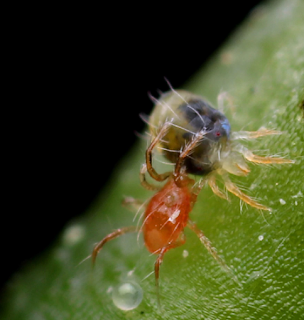

Figure 1. An image of persimilis predating on a two-spotted spider mite. Photo credit: Biotactics Inc. 


This new persimilis can also be purchased in bottle form. But grower be warned! It was interestingly noted that these predators are not their characteristic red colour when you receive them from the insectary. That colour develops on the persimilis as they start feeding on spider mites. This acts as an added bonus when it comes to your scouting efforts. If you note which predators have transitioned from milky to red, you can get a sense of the pest pressure in the space and how effective your release was at managing the spider mite population.

I want to give a huge shoutout to the Cannabis Cultivation & Science Podcast for keeping up with the biocontrol world and spreading the word on cool innovations like this one!

______________________________________________________________

Posted by: Talia Plaskett


Making the Most of your IPM Programs

Friday, October 8, 2021

    You found out that you have an insect infestation in your crop, and identified the causal agent. What comes next in deciding how to handle it?

  1.       You need to consider the life stage of the target pest. Biological controls are skilled at targeting pests, but this can be restricted to certain stages of the life cycle. Those that are specialized at targeting larvae are not going to be able to knock back a population that is mostly comprised of eggs or adults. While interruption of the life cycle is important for combatting pest outbreaks, you won't necessarily limit the feeding damage that is to come as a result of the current population. 
  2.       The life stage of the pest is not the only thing to consider. If you are relying on insects to control your pest population, you need to consider the life stage of the biological you are wanting to use. Releasing eggs compared to releasing larvae can result in different levels of control, establishment and active period in the crop. 
  3.       Life stage, life stage, life stage! Where is the crop at in terms of its production cycle? Some biologicals are best applied in the early stages compared to the later ones. For example, releasing an agent that is going to lay eggs that hatch and congregate around the flowers is going to render your product unusable. 
  4.       What are the growing conditions in the production space? Similar to plants, diseases and insect pests, biological interventions are going to have an optimum set of conditions to maximize performance. This is especially important when you are growing at lower/higher temperatures and abnormal humidity levels. Some biologicals are going to operate better at lower temperatures ( ex. 10C) compared to others, and you don't want to waste your time repeat testing an agent that is not going to thrive in that particular setting.

      Now that we have decided which biological control agents we want to use, there are a few other things to keep in mind. 

  1.       How healthy are the predators that I've ordered? It is important to check the viability of your biological control agents upon receiving them from the insectary. There can be issues with rearing, storage/shipping etc, which can result in sub-optimal pest management. By implementing these health checks before releasing into the crop, you can ensure that you are getting the best quality product and setting your IPM program up for success
  2.       It is ideal that you are always releasing fresh biological agents. By storing them for long periods of thime, you are running the risk that they will parasitize each other in their storage container. You could also be reducing the activity of the agents, and will need to spend more money in the long run. By purchasing the amount that you will release each time around, you are one step closer to maximizing the effectiveness of your agent. 
  3.       Are the agents I've ordered compatible with each other? While it is likely that you will get some overlap of introduced biological control agents targeting each other, you want to make sure that is not the norm
  4.       Are the agents I've ordered compatible with the spray activities happening in the grow room? Oil sprays that are used to suppress insects and disease are not always selective when it comes to drowning out pests.

   Maximizing success and implementing a successful IPM strategy can be a long process, but  taking these things into consideration should help get things started. Preventative pest management strategies are crucial in creating and maintaining a healthy and productive grow space, and there is no time like the present to dive in and re-evaluate your current strategy! 

      Posted by: Talia Plaskett


Cannabis Research License Announcement

Monday, September 27, 2021

We are pleased to announce that we recently obtained out research license for cannabis edibles and drinkable. Through the following services and working with our analytical team we can help you with your cannabis edible journey.

Product Development

Whether you’re looking to get a new product to market or perfect an existing one, our skilled and integrated team can help you achieve high-quality results with a competitive edge.

Ensuring Potency

In conjunction with the analytical team, we can help with your formulation to achieve accurate potency and homogenous product. Testing can then be completed to determine how potency will be maintained over time, making sure it is still with in the specific cannabis regulations.

Scale up

You’ve developed a product that you’re proud of, and now it’s time to dive into the most crucial step in the commercialization process: scale up. Our experts can set you on the path to expanded opportunities for revenue growth

Shelf-Life Evaluation

Determining the shelf life of your product is an integral step in getting your product to market. Our team has the know-how and equipment to make it happen, like our stability chambers used to conduct trials in various conditions

                                        __________________________________

For more information and how to contact us please visit out our website - https://bloomlabs.ca/

What to Spray, What to Spray...

Friday, September 10, 2021

Pest and disease management in cannabis is no walk in the park! Not only are you limited in what you can apply to the crop, there are also a lot of products out there to chose from! 

Never fear, Perennia is here!

Every year, the production specialists take the time to create/update our spray guides. These guides contain a wealth of information on registered products, formulations, application rates, REI, PHI and noteworthy comments on working with that particular product. 

While this is no substitute for the actual product label, it can help narrow down the choices of what works best for your grow. Say, for example, you are having an issue with spider mites. You can scroll down to the 'Mites' portion of the guide (or 'control - Find' for the tech savy), and take a look at all of the products that are registered for use in cannabis against mites. 

Some products are going to be more compatible with your production system than others. Say, for example, you have been applying sulfur to manage powdery mildew. Oil sprays are not going to be your best choice to tackle mites in this case, as these may cause some funky side effects on your canopy. This is a fast way to narrow down your search to a product that will be more suitable. 

From there, double check the label, and ensure that you are applying based on their recommendations. Product registrations can change any time of year, and our guides, updated every March, are not going to capture things that have taken place in April...May...June etc. 

Spray happy my friends!


Posted by: Talia Plaskett

To Prune, or Not to Prune...

Tuesday, August 17, 2021


Pruning is an important cultural practice which helps to control the humidity in the canopy, contributing to lower overall pest and disease pressure. As with anything, however, there is more than meets they eye when it comes to the best ways to prune your plants.

With the unexpected onset of cool and wet conditions in the Valley, it seems to be an appropriate time to cover some best practices when it comes to pruning your crop. These will help manage the risk associated with Botrytis infection and keep your crop growing strong.

Figure 1. An image of a botrytis infestation on raspberry. Photo credit: Amber Dort, Perennia

·         Be sure to remove the entire leaf and leaf stem, cutting right up to the main growing stem. Allowing residual tissue to stay there makes you vulnerable to botrytis infection, which will travel up the stem stub and into your main stem.

·         Try to prune on sunny days. This will ensure that there is less moisture in the growing space, and will dry up the newly created pruning wounds before temperature drops again through the night

·         Prune your plants first thing in the morning – this gives the plant an entire day to mend the pruning wounds, before temperatures drop, and condensation collects inside the production space

·        Try not to prune too heavily at once. The plant will need some time to adjust to the new source/sink ratio (# of leaves to # of buds), and it is best not to shock the system. If you have some ambitious pruning plans, spread them out over time

·         Pruning efforts are typically concentrated on the bottom of the plant, but don’t forget about the rest of the canopy. If you find there are overly dense sections in the middle or top, do not hesitate to remove one or two leaves to create more air space. Look at the overall plant before pulling leaves off and assess where the plant needs it most.

Regular pruning schedules are highly recommended and will help create a more consistent crop production schedule. Consistency from crop to crop is key, and managing air flow through the canopy is going to drastically reduce the amount of botrytis in the crop. 


Posted by: Talia Plaskett

Field Research Services

Friday, August 6, 2021


We are excited to share with you the launch of our new Field Research Services webpage! Our new site fully showcases our team and the services available to support agriculture research in Nova Scotia.

Our team's knowledge and skillset ensures we are fully equipped to deliver on-farm extension and small plot research. We pride ourselves on performing quality research to ensure accurate results and client satisfaction.

Learn more about the services we offer and take a look at our projects page to see some of our previous work.

Feel free to reach out to us anytime. We would be happy to discuss your research needs.


Virtual Field Days 2021

Friday, July 23, 2021

Interested in seeing what is happening in agriculture across the province? Perennia's Virtual Field Days are a great way to sample a handful of topics across many different commodities. These 30-minute tours  happen once a week throughout the month of August, and are free to join. Check out the session descriptions and specific topics below!

August 3 - Redefining Horticulture

August 10 - Technology in Agriculture

August 17 - Optimizing Production

August 24 - Livestock Management


Posted by: Talia Plaskett

Let's Light It Up!

Friday, July 16, 2021

Cannabis production takes place both indoors and outdoors in Nova Scotia. While both production systems have their pros and cons, there is no denying that indoor production allows for increased consistency in environmental conditions, as well as year-round growing (structure dependent).  

For greenhouse producers, one of the major hiccups in year-round production is the amount of light available during the winter months. In order to maximize growth (and yield), certain inputs are required to create continuity and consistency through the seasons - One of these potential inputs is artificial lighting. 


For strictly indoor producers, artificial lighting is crucial. This is what will fuel your plant growth year round, and will make up a significant portion of your initial investment and monthly energy costs. 

For those of you who are considering protected production, the adoption of indoor lighting is a big investment, and there are a lot of variables to consider in the decision-making process. Check out our newest factsheet on greenhouse lighting, which explores the pros and cons of LED versus traditional light fixtures, defines light and the various units used to describe it, as well as the tools required to measure it.   


Posted by: Talia Plaskett


SUMMARY of BugBites! Session 5: Fungus Gnats and Shore Flies

Friday, July 2, 2021

Review Part 2: Shore Fly Management

While shore files (Ephydridae) are primarily seen as a nuisance in protected production spaces, they can also degrade the quality of your plants. Adults are known to leave 'fly vomit' behind as they make their way through the production space. These small black specks can be found on plant parts and growing surfaces, and are no aesthetic addition to your pristine green canopies. 

The following information is a summary of session 5 of the BugBites Series: Fungus Gnats and Shorefly Suppression with Beneficial Organisms. To watch the full session, click here

Pest Description: 

Adult shore flies, although similar in size to a fungus gnat, are comparable to regular house flies in appearance. These insects can be identified by the 5 white spots on their wings. 


Larvae are semi-aquatic, which can be identified by their Y-shaped breathing tubes. The larvae are semi-aquatic in nature, and can range from cream-coloured to brown.  


Monitoring and Scouting: 

Traditional yellow sticky cards are effective for monitoring and catching adult shore flies. These insects are much stronger fliers compared to fungus gnats, so placement of the yellow sticky cards right at the soil line is less critical. 

Biological Control Options: 

The best method for managing shore fly populations is to manage algae build-up around the facility. The larvae, which are semi-aquatic, rely on algae as their food source. By removing a key part of their reproductive cycle, pest population sizes will be limited. The best way to manage algae is to repair any leaky points along the irrigation system, and carefully sloped surfaces to keep water from pooling. 

Next is insect management. By conducting regular scouting checks of the crop, and maintaining populations of biological control agents, you can limit the degree of pest infestation.

Dalotia coriaria; Rove beetle

  • Predator to both shoreflies and fungus gnats
  • Both adults and larvae are predatory
    • Orange larvae are noticeable in the soil
    • Adults readily move around via flight
  • Ready establish in greenhouses
  • Works well in hydroponic systems

Figure 2. A photo of a rove beetle in the adult (left) and larval (right) stages. stuck to a yellow sticky card.  Image taken from the BugBites! Session 5 presentation

The use of rearing boxes allows for a slow-release approach, and will help maintain beetle populations through the season. Rearing boxes can be as basic as media (ex. peat, vermiculite) set inside a Tupperware container, and supplemented with food (ex dog or fish food, artemia). It is crucial to keep this moist, but not wet. These can be placed under benches.

Steinernema feltiae; entemopathogenic nematode

  • Target fungus gnats, shoreflies, thrips pupae and many others
  • Forage in the top inch or two of the soil
    • Water into your growing media lightly- if they get too far in, they will not be able to combat pest populations
  • Not highly mobile
  • 50-78F are ideal conditions
    • Well suited for greenhouse environments
  • Susceptible to being washed away in rockwool
    • When growing in rockwool, apply after the last irrigation of the day to give them a chance to establish

Steinernema carpocapsae, entemopathogenic nematode

  • Target shore flies, and thrips pupae
  • Good at finding mobile pests
  • No problem working in/establishing on rockwool
  • Lives on soil surface (use very little water when applying to prevent from washing them too deep into the growing media)
  • Ideal temp is 57-84
    • well suited for greenhouse environments

* Both nematodes listed here can be applied together, since they focus on different parts of the soil.


The key for management here is prevention. By adding nematodes and rove beetles into your production routine, and managing algae growth around the facility, shore fly populations should be significantly reduced. 


Posted by: Talia Plaskett

SUMMARY of BugBites! Session 5: Fungus Gnats and Shore Flies

Friday, June 25, 2021

Review pt 1:Fungus Gnats

Although fungus gnats (Sciaridae) are primarily seen as a nuisance in indoor production spaces, they are responsible for a lot more than that! As a result of their favourite food source (plant roots), these pests are capable of acquiring and spreading fungal disease amongst the crop.

The following information is a summary of session 5 of the BugBites Series: Fungus Gnats and Shorefly Suppression with Beneficial Organisms. To watch the full session, click here

Pest Description: 

Adult fungus gnats are mosquito-like insects with long legs, and a characteristic y-shaped wing vein. Adults can be found hanging around or near the soil, mostly under plant canopy. The fungus gnat larvae are white with a shiny black head. Larvae spend most of their time underground and will feed on the roots. 

Figure 1. A photo of an adult fungus gnat stuck to a yellow sticky card. Below, is an image of the fungus gnat larvae. If you look closely, you can see the characteristic black head at the end of the larva. Image taken from the BugBites! Session 5 presentation. 

Monitoring and Scouting: 

Adults are not strong fliers, meaning that sticky cards will only be effective when placed close to the soil line. If placed correctly, traditional sticky cards are a great tool to monitor population sizes.

As an attractant, some growers will use half a potato, or a potato slice, placed in a pot to draw larvae up from the soil. As the larvae are accustomed to feeding on roots, the use of a tuber is a big draw.

For the adults there are various traps available. These traps typically involve the use of an attractant (ex. UV bulb) and a way to capture the insects (sticky cards, soapy water solution etc.). This is useful for general scouting purposes as well as mass trapping.

Biological Control Options: 

As with any biological control program, prevention is the first line of defense in controlling population sizes. By conducting regular scouting checks of the crop, and maintaining populations of biological control agents, you can limit the degree of pest infestation.

Dalotia coriaria; Rove beetle

  •  Predator to both shoreflies and fungus gnats
  •  Both adults and larvae are predators
    • Orange larvae will be noticeable in your soil
    • Adults readily move around via flight
  • Establish readily in greenhouses and work well in hydroponic systems

Figure 2. A photo of a rove beetle in the adult (left) and larval (right) stages. stuck to a yellow sticky card.  Image taken from the BugBites! Session 5 presentation

The use of rearing boxes allows for a slow-release approach and will help maintain beetle populations through the season. Rearing boxes can be as basic as media (ex. peat, vermiculite) set inside a Tupperware container, and supplemented with food (ex dog or fish food, artemia). It is crucial to keep this moist, but not wet. These can be placed under benches.

Bacillus thuringeniensis israeleinsis 

  •  Functions as a stomach toxin for fungus gnats
  •  Best applied via soil drench or chemigation. Irrigation is not ideal as the soil needs to get very wet to allow for good establishment of the biopesticide

Stratiolaelaps scimitus; predatory mite

  • Target fungus gnat larvae
  •  Well suited for greenhouse environments: optimum development temperature of 25oC (77oF)
    • Ideal range is 15-30oC (59-86oF)
  • Live in the top half inch of the soil: best applied to the substrate surface after transplant
    • Want to avoid burying too deep in the growing media
  • Does not establish well in rockwool
  • Persistent control agents, and can provide season-long protection

                                               
Figure 3. An image of an adult predatory mite. Image taken from the BugBites! Session 5 presentation

S. scimitus can be mixed with Dalotia, but it is not recommended to introduce them before adding into the crop. They will feed on each other, so make sure they are spread evenly throughout the canopy when distributed.

Steinernema feltiae; entemopathogenic nematode

  • Target fungus gnats, shoreflies, thrips pupae and many others
  • Forage in the top inch or two of the soil
    • Water into your growing media lightly- if they get too far in, they will not work
  • Not highly mobile
  • Well suited for greenhouse environments with an ideal temperature range of 10-25oC (50-78oF)
  • Susceptible to being washed away in rockwool
    • When growing in rockwool, apply after the last irrigation of the day to give them a chance to establish

By ensuring thorough protection against all life stages of the fungus gnat, you should be able to keep populations at bay! Prevention is everything, so be sure to apply biologicals preventatively and as needed.

Posted by: Talia Plaskett


PREVIOUS Bloom to Bud Posts

Blog Archive