Showing posts with label Nematodes. Show all posts

What's New with Biological Control?

Tuesday, November 9, 2021

 2021 has seen a lot of new and exciting things in the world of IPM with some of the tools available to producers for managing pest populations. Please find a quick summary of some of these new developments below with their corresponding contact information – this is a list of curated material from various sources, credit must be given where credit is due!

1)Introducing Anystis, the new generalist predator in our toolbox

 Anystis is a new generalist predator which was discovered and trialed by Vineland Research and Innovation Centre. This predator has shown control over thrips and spider mites as well as suppression of aphid populations. Not only that, but it also preys on Echinothrips and mealybugs, which currently do not have effective options when it comes to biological control agents! Not only that, but Anystis is compatible with other commonly used biocontrol agents, meaning less stress about adjusting your current regimes and more success overall when it comes to targeting your problematic pests. 

The use of Anystis has been validated in commercial greenhouse trials on gerbera and sweet pepper in Ontario, and further supported by promising results generated through recent trials at Niagara College for use in cannabis to control aphids. The predator has been transferred to Applied Bio-nomics Ltd for scaling up the rearing system and commercialization, and have a limited number of mites available for growers to try.

For more information on Anystis, contact Rose Buitenhuis, PhD Senior Research Scientist, Biological Control at Vineland Research.


2)Slow-release method of nematodes

The current application of beneficial nematodes is limited to sprenches, or drenches, across the surface of the growing media. The biggest targets for beneficial nematodes are the larvae of fungus gnats and western flower thrips, as well as onion thrips pupae. While the product is quite effective, the current application method to the crop sees a few technical difficulties. These drenches/sprenches are not the most effective when it comes to penetrating deeper into the growing mix, and they must be applied on a weekly basis. Not only that, but the current methods of distribution sees a very poor storage capacity – all must be distributed at once, which leaves the small producers in a bit of a financial pinch!

E-Nema is a new tech company based in Germany. They have come out with a slow-release method for these beneficial nematodes which tackles some of the difficulties associated with the existing system. These look similar to tapioca pearls, and are designed to be incorporated into the growing mix before planting. Then, over time, they will slowly release nematodes through the entirety of your growing container. These pearls are very safe, and do not contain any harmful chemicals. In addition to that, they store quite well, which is a win for smaller producers who may not need massive volumes to be distributed all at once. The reintroduction and inoculation of low doses of nematodes has proven to be more effective than coming in hot and heavy with one dose during the cycle, and this technology allows just that! 

BioBee will be the distributer for this new product, so be sure to keep your eyes peeled for that! I want to give a huge shoutout to the Cannabis Cultivation & Science Podcast for keeping up with the biocontrol world and spreading the word on cool innovations like this one!


3)New rearing methodology for Phytoseiulus persimilus

Our old reliable predatory mite is coming at us new and improved! BioBee has re-evaluated their current rearing methods for persimilis and has landed on a product that addresses some of the downfalls to the original release system. The original system sees that the predators are reared on spider mites, meaning they come out of their sachets starved and ready to tackle some serious spider mites. While that works well in heavily infested crops, it doesn’t bode well for the low pest pressure grow room, or the preventative release strategy either. This new product raises the predators on mite eggs, meaning that each sachet will come with a variety of life stages, and each sachet will have a long-life span overall as these different stages progress towards adulthood. These sachets can see up to 12 days to release the contents, giving you almost 2 weeks of release from one purchase. The new food source sees that these mites are not as hungry as they would be when raised on spider mites. This means they have time to establish in the crop, as well as hunt down those low density mites that are scattered through the room. Not only that, but there is no carrier mixed in with these predators. This is a huge win for producers of heavily-trichomed crops, as their plants will no longer be littered with pesky lingering carrier bits.
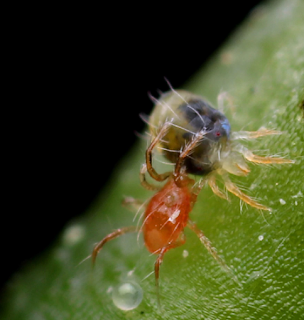

Figure 1. An image of persimilis predating on a two-spotted spider mite. Photo credit: Biotactics Inc. 


This new persimilis can also be purchased in bottle form. But grower be warned! It was interestingly noted that these predators are not their characteristic red colour when you receive them from the insectary. That colour develops on the persimilis as they start feeding on spider mites. This acts as an added bonus when it comes to your scouting efforts. If you note which predators have transitioned from milky to red, you can get a sense of the pest pressure in the space and how effective your release was at managing the spider mite population.

I want to give a huge shoutout to the Cannabis Cultivation & Science Podcast for keeping up with the biocontrol world and spreading the word on cool innovations like this one!

______________________________________________________________

Posted by: Talia Plaskett


SUMMARY of BugBites! Session 5: Fungus Gnats and Shore Flies

Friday, July 2, 2021

Review Part 2: Shore Fly Management

While shore files (Ephydridae) are primarily seen as a nuisance in protected production spaces, they can also degrade the quality of your plants. Adults are known to leave 'fly vomit' behind as they make their way through the production space. These small black specks can be found on plant parts and growing surfaces, and are no aesthetic addition to your pristine green canopies. 

The following information is a summary of session 5 of the BugBites Series: Fungus Gnats and Shorefly Suppression with Beneficial Organisms. To watch the full session, click here

Pest Description: 

Adult shore flies, although similar in size to a fungus gnat, are comparable to regular house flies in appearance. These insects can be identified by the 5 white spots on their wings. 


Larvae are semi-aquatic, which can be identified by their Y-shaped breathing tubes. The larvae are semi-aquatic in nature, and can range from cream-coloured to brown.  


Monitoring and Scouting: 

Traditional yellow sticky cards are effective for monitoring and catching adult shore flies. These insects are much stronger fliers compared to fungus gnats, so placement of the yellow sticky cards right at the soil line is less critical. 

Biological Control Options: 

The best method for managing shore fly populations is to manage algae build-up around the facility. The larvae, which are semi-aquatic, rely on algae as their food source. By removing a key part of their reproductive cycle, pest population sizes will be limited. The best way to manage algae is to repair any leaky points along the irrigation system, and carefully sloped surfaces to keep water from pooling. 

Next is insect management. By conducting regular scouting checks of the crop, and maintaining populations of biological control agents, you can limit the degree of pest infestation.

Dalotia coriaria; Rove beetle

  • Predator to both shoreflies and fungus gnats
  • Both adults and larvae are predatory
    • Orange larvae are noticeable in the soil
    • Adults readily move around via flight
  • Ready establish in greenhouses
  • Works well in hydroponic systems

Figure 2. A photo of a rove beetle in the adult (left) and larval (right) stages. stuck to a yellow sticky card.  Image taken from the BugBites! Session 5 presentation

The use of rearing boxes allows for a slow-release approach, and will help maintain beetle populations through the season. Rearing boxes can be as basic as media (ex. peat, vermiculite) set inside a Tupperware container, and supplemented with food (ex dog or fish food, artemia). It is crucial to keep this moist, but not wet. These can be placed under benches.

Steinernema feltiae; entemopathogenic nematode

  • Target fungus gnats, shoreflies, thrips pupae and many others
  • Forage in the top inch or two of the soil
    • Water into your growing media lightly- if they get too far in, they will not be able to combat pest populations
  • Not highly mobile
  • 50-78F are ideal conditions
    • Well suited for greenhouse environments
  • Susceptible to being washed away in rockwool
    • When growing in rockwool, apply after the last irrigation of the day to give them a chance to establish

Steinernema carpocapsae, entemopathogenic nematode

  • Target shore flies, and thrips pupae
  • Good at finding mobile pests
  • No problem working in/establishing on rockwool
  • Lives on soil surface (use very little water when applying to prevent from washing them too deep into the growing media)
  • Ideal temp is 57-84
    • well suited for greenhouse environments

* Both nematodes listed here can be applied together, since they focus on different parts of the soil.


The key for management here is prevention. By adding nematodes and rove beetles into your production routine, and managing algae growth around the facility, shore fly populations should be significantly reduced. 


Posted by: Talia Plaskett

SUMMARY of BugBites! Session 5: Fungus Gnats and Shore Flies

Friday, June 25, 2021

Review pt 1:Fungus Gnats

Although fungus gnats (Sciaridae) are primarily seen as a nuisance in indoor production spaces, they are responsible for a lot more than that! As a result of their favourite food source (plant roots), these pests are capable of acquiring and spreading fungal disease amongst the crop.

The following information is a summary of session 5 of the BugBites Series: Fungus Gnats and Shorefly Suppression with Beneficial Organisms. To watch the full session, click here

Pest Description: 

Adult fungus gnats are mosquito-like insects with long legs, and a characteristic y-shaped wing vein. Adults can be found hanging around or near the soil, mostly under plant canopy. The fungus gnat larvae are white with a shiny black head. Larvae spend most of their time underground and will feed on the roots. 

Figure 1. A photo of an adult fungus gnat stuck to a yellow sticky card. Below, is an image of the fungus gnat larvae. If you look closely, you can see the characteristic black head at the end of the larva. Image taken from the BugBites! Session 5 presentation. 

Monitoring and Scouting: 

Adults are not strong fliers, meaning that sticky cards will only be effective when placed close to the soil line. If placed correctly, traditional sticky cards are a great tool to monitor population sizes.

As an attractant, some growers will use half a potato, or a potato slice, placed in a pot to draw larvae up from the soil. As the larvae are accustomed to feeding on roots, the use of a tuber is a big draw.

For the adults there are various traps available. These traps typically involve the use of an attractant (ex. UV bulb) and a way to capture the insects (sticky cards, soapy water solution etc.). This is useful for general scouting purposes as well as mass trapping.

Biological Control Options: 

As with any biological control program, prevention is the first line of defense in controlling population sizes. By conducting regular scouting checks of the crop, and maintaining populations of biological control agents, you can limit the degree of pest infestation.

Dalotia coriaria; Rove beetle

  •  Predator to both shoreflies and fungus gnats
  •  Both adults and larvae are predators
    • Orange larvae will be noticeable in your soil
    • Adults readily move around via flight
  • Establish readily in greenhouses and work well in hydroponic systems

Figure 2. A photo of a rove beetle in the adult (left) and larval (right) stages. stuck to a yellow sticky card.  Image taken from the BugBites! Session 5 presentation

The use of rearing boxes allows for a slow-release approach and will help maintain beetle populations through the season. Rearing boxes can be as basic as media (ex. peat, vermiculite) set inside a Tupperware container, and supplemented with food (ex dog or fish food, artemia). It is crucial to keep this moist, but not wet. These can be placed under benches.

Bacillus thuringeniensis israeleinsis 

  •  Functions as a stomach toxin for fungus gnats
  •  Best applied via soil drench or chemigation. Irrigation is not ideal as the soil needs to get very wet to allow for good establishment of the biopesticide

Stratiolaelaps scimitus; predatory mite

  • Target fungus gnat larvae
  •  Well suited for greenhouse environments: optimum development temperature of 25oC (77oF)
    • Ideal range is 15-30oC (59-86oF)
  • Live in the top half inch of the soil: best applied to the substrate surface after transplant
    • Want to avoid burying too deep in the growing media
  • Does not establish well in rockwool
  • Persistent control agents, and can provide season-long protection

                                               
Figure 3. An image of an adult predatory mite. Image taken from the BugBites! Session 5 presentation

S. scimitus can be mixed with Dalotia, but it is not recommended to introduce them before adding into the crop. They will feed on each other, so make sure they are spread evenly throughout the canopy when distributed.

Steinernema feltiae; entemopathogenic nematode

  • Target fungus gnats, shoreflies, thrips pupae and many others
  • Forage in the top inch or two of the soil
    • Water into your growing media lightly- if they get too far in, they will not work
  • Not highly mobile
  • Well suited for greenhouse environments with an ideal temperature range of 10-25oC (50-78oF)
  • Susceptible to being washed away in rockwool
    • When growing in rockwool, apply after the last irrigation of the day to give them a chance to establish

By ensuring thorough protection against all life stages of the fungus gnat, you should be able to keep populations at bay! Prevention is everything, so be sure to apply biologicals preventatively and as needed.

Posted by: Talia Plaskett


PREVIOUS Bloom to Bud Posts