Showing posts with label Pest Management. Show all posts

Dealing with Molds, Mildews, and other Nasties in Cannabis Production

Friday, December 9, 2022

The following is a summary of a presentation put together by Michael Brownbridge, the Biological Program Manager at Bioworks, for the 2022 Canadian Greenhouse Conference. The focus of his talk looks at dealing with disease management using cultural practices and microbial fungicides. For a full copy of the slide deck, check out the 2022 CGC Presentation archives posted.

Cultural practices for disease reduction/prevention:

Cultural practices are day-to-day preventative measures that can be taken that, when properly implemented and adhered to, can collectively reduce the amount of disease introduced/spread through a production space. With a limited number of registered active ingredients in cannabis, it is important to use every tool possible to maintain crop productivity and quality.  Some examples of cultural practices to reduce the probability of disease include:

  •  Strict cleaning protocols (room sterilization, use of clean tools etc)
  •  Ensure mother plants/ cuttings are disease free by purchasing Verified Clean Stock
  • Monitor and maintain suitable growing conditions in each production space
  • Consider ‘order of entry’ when moving through the facility in a day – highly sensitive spaces (propagation rooms, for example) should be entered early in the day while workers are ‘clean’ as opposed to the end of a day working with other plants
  • When receiving plants from outside of the facility, a quarantine is highly recommended

o   While this is valuable from a disease perspective, it also comes in handy to reduce invasive insect populations as well. Broad mites, two-spotted spider mite, hemp russet mite, western flower thrips, and aphids (both rice root and cannabis aphid) are common hitch hikers on imported materials. All of these are hard to detect and have rapid life cycles. While they may not be noticeable upon arrival, a few days of quarantine may reveal populations of tiny insects feasting on the new plant material.

One of the best ways to keep a facility clean is to invest in regular scouting missions and disease screens, especially within the mother room. Diseases caused by Pythium and Fusarium are not always going to show symptoms, which leaves you vulnerable to passing the disease agents into the next round of cuttings. While it is commonly practiced taking cuttings from the top of the plant ‘because the disease isn’t there yet’, recent data from the University of Kentucky shows that although titers may be lower in top parts of the plant, disease is still present. The best way to protect the viability of your future cuttings/crops is to submit plant tissue samples for disease analysis. Taking a subsampling of tissue from different parts of the plant should give an accurate depiction of what may be brewing beneath the surface.

I Have Diseases Developing in the Crop – Now What?

In addition to his work on powdery mildew (as seen in the previous blog post), Zamir Punja of Simon Fraser University conducted some biofungicide efficacy trials against Fusarium oxysporum. Check out his findings below:

The water control is intended to show the level of disease present without a formal introduction of F. oxysporum. The second treatment from the left, referred to as 'Fusarium (+)', shows that the disease isolate used was effective at causing symptoms, and the level of disease that observed throughout the trial when there was no intervention provided. 

Now that the two control measures have been addressed, its time to compare product performance. Prestop showed to be the most effective at reducing disease in the inoculated plants. The 'a' on top of the bar here denotes that the level of disease after regular treatment with Prestop is not statistically different than the control treatment. Next up, we see that Rootshield, Asperello and Stargus had significantly less disease compared to the 'Fusarium (+)' treatment. This shows us that these are effective products for reducing symptom development despite the presence of the pathogen. While they may not have reduced disease to the same degree as Prestop, their proper application should lessen the impacts caused by F. oxysporum. Finally we see that Rhapsody and Regalia did not perform very well in this particular trial. Neither product was able to offer any reduction in disease severity compared to the inoculated control. 


Dr. Punja conducted similar work for product efficacy against Pythium spp. Looking at the graph above, we can see that 14 days post inoculation with P. myriotylum, plants that were treated with Rootshield and Prestop showed significantly less disease compared to plants that received no treatment. There is no significant difference in the level of disease suppression between these two products against this particular pathogen, based on the findings of this study, which gives growers a bit more flexibility when selecting products for disease suppression.


When in doubt, integrated pest management is the best strategy for reducing the impacts of disease and insect pressure in indoor cannabis production!
Posted by: Talia Plaskett


2022 Updated Spray Guide

Friday, April 29, 2022

The process of selecting products for pest and disease management can be daunting - not only is there a wide selection of products to chose from, but we have to consider compatibility amongst products, the growing conditions within the production space, as well as the impact of these products on any biological control agents that may have been released into the space.  

Every year Perennia's Protected Crop Specialist takes the time to go through and update the spray guide to account for changes that have happened over the last year. Suppliers can be known to change application rates, recommendations for applications, formulations and REI/PHI values as well, and it is important to make sure that you are up to date on these things to maintain the health of your crop, efficacy of the products, and continued compliance with Health Canada recommendations.  

While this spray guide is no substitute for the actual product label, it can help narrow down the choices of what works best for your grow. Say, for example, you are having an issue with spider mites. You can scroll down to the 'Mites' portion of the guide (or 'control - Find' for the tech savy), and take a look at all of the products that are registered for use in cannabis against mites. 

Some products are going to be more compatible with your production system than others. For example, say you have been applying sulfur to manage powdery mildew. Oil sprays are not going to be your best choice to tackle mites in this case, as these may cause some funky side effects on your canopy. This is a fast way to narrow down your search to a product that will be more suitable. From there, double check the label, and ensure that you are applying based on their recommendations. Product registrations can change any time of year, and our guides, updated every March, are not going to capture things that have taken place in April...May...June etc. 

What are some of the things to look out for this year?

There are a handful of changes to product labels from 2021
  • Lalstop is no longer registered for use in cannabis
    • the active ingredient Gliocladium catenulatum can still be found in other products, so if this was part of your usual rotation there are alternative products available that should behave the same way
  • Milstop has differentiated the application rate to be used depending on where you are growing - ourdoor and indoor rates are no longer the same
  • Expansion of the label for Rootshield HC Biological Fungicide, which now can be applied as a foliar spray to tackle botrytis issues
  • Bioceres label has been expanded to include use against spider mites 
  • Purespray FX and Regalia Maxx were only registered for indoor use, but this year we see that it can be used for field production as well
  • Two new active ingredients have been registered for use in cannabis!
    • MustGrow Crop Biofumigant, which can be used against species of the Pythium genus, Fusarium genus, Verticillium dahlia and root knot nematode, relies on the active ingredient  oriental mustard seed meal
    • Timorex Gold controls botrytis, powdery mildew and white mold via the active ingredient tea tree oil
Interested in learning more about changes to horticultural products for 2022? Check out the recording of our webinar 'Product Changes Impacting Horticulture' for the full list of changes.

Otherwise, be sure to check out the updated spray guide, and don't hesitate to reach out if you have any questions! 

Spray happy my friends!


Posted by: Talia Plaskett

What's New with Biological Control?

Tuesday, November 9, 2021

 2021 has seen a lot of new and exciting things in the world of IPM with some of the tools available to producers for managing pest populations. Please find a quick summary of some of these new developments below with their corresponding contact information – this is a list of curated material from various sources, credit must be given where credit is due!

1)Introducing Anystis, the new generalist predator in our toolbox

 Anystis is a new generalist predator which was discovered and trialed by Vineland Research and Innovation Centre. This predator has shown control over thrips and spider mites as well as suppression of aphid populations. Not only that, but it also preys on Echinothrips and mealybugs, which currently do not have effective options when it comes to biological control agents! Not only that, but Anystis is compatible with other commonly used biocontrol agents, meaning less stress about adjusting your current regimes and more success overall when it comes to targeting your problematic pests. 

The use of Anystis has been validated in commercial greenhouse trials on gerbera and sweet pepper in Ontario, and further supported by promising results generated through recent trials at Niagara College for use in cannabis to control aphids. The predator has been transferred to Applied Bio-nomics Ltd for scaling up the rearing system and commercialization, and have a limited number of mites available for growers to try.

For more information on Anystis, contact Rose Buitenhuis, PhD Senior Research Scientist, Biological Control at Vineland Research.


2)Slow-release method of nematodes

The current application of beneficial nematodes is limited to sprenches, or drenches, across the surface of the growing media. The biggest targets for beneficial nematodes are the larvae of fungus gnats and western flower thrips, as well as onion thrips pupae. While the product is quite effective, the current application method to the crop sees a few technical difficulties. These drenches/sprenches are not the most effective when it comes to penetrating deeper into the growing mix, and they must be applied on a weekly basis. Not only that, but the current methods of distribution sees a very poor storage capacity – all must be distributed at once, which leaves the small producers in a bit of a financial pinch!

E-Nema is a new tech company based in Germany. They have come out with a slow-release method for these beneficial nematodes which tackles some of the difficulties associated with the existing system. These look similar to tapioca pearls, and are designed to be incorporated into the growing mix before planting. Then, over time, they will slowly release nematodes through the entirety of your growing container. These pearls are very safe, and do not contain any harmful chemicals. In addition to that, they store quite well, which is a win for smaller producers who may not need massive volumes to be distributed all at once. The reintroduction and inoculation of low doses of nematodes has proven to be more effective than coming in hot and heavy with one dose during the cycle, and this technology allows just that! 

BioBee will be the distributer for this new product, so be sure to keep your eyes peeled for that! I want to give a huge shoutout to the Cannabis Cultivation & Science Podcast for keeping up with the biocontrol world and spreading the word on cool innovations like this one!


3)New rearing methodology for Phytoseiulus persimilus

Our old reliable predatory mite is coming at us new and improved! BioBee has re-evaluated their current rearing methods for persimilis and has landed on a product that addresses some of the downfalls to the original release system. The original system sees that the predators are reared on spider mites, meaning they come out of their sachets starved and ready to tackle some serious spider mites. While that works well in heavily infested crops, it doesn’t bode well for the low pest pressure grow room, or the preventative release strategy either. This new product raises the predators on mite eggs, meaning that each sachet will come with a variety of life stages, and each sachet will have a long-life span overall as these different stages progress towards adulthood. These sachets can see up to 12 days to release the contents, giving you almost 2 weeks of release from one purchase. The new food source sees that these mites are not as hungry as they would be when raised on spider mites. This means they have time to establish in the crop, as well as hunt down those low density mites that are scattered through the room. Not only that, but there is no carrier mixed in with these predators. This is a huge win for producers of heavily-trichomed crops, as their plants will no longer be littered with pesky lingering carrier bits.


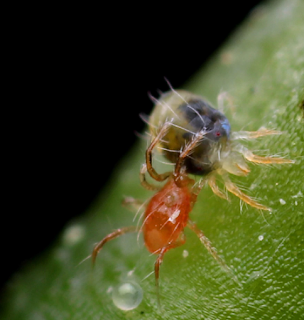
Figure 1. An image of persimilis predating on a two-spotted spider mite. Photo credit: Biotactics Inc. 


This new persimilis can also be purchased in bottle form. But grower be warned! It was interestingly noted that these predators are not their characteristic red colour when you receive them from the insectary. That colour develops on the persimilis as they start feeding on spider mites. This acts as an added bonus when it comes to your scouting efforts. If you note which predators have transitioned from milky to red, you can get a sense of the pest pressure in the space and how effective your release was at managing the spider mite population.

I want to give a huge shoutout to the Cannabis Cultivation & Science Podcast for keeping up with the biocontrol world and spreading the word on cool innovations like this one!

______________________________________________________________

Posted by: Talia Plaskett


Making the Most of your IPM Programs

Friday, October 8, 2021

    You found out that you have an insect infestation in your crop, and identified the causal agent. What comes next in deciding how to handle it?

  1.       You need to consider the life stage of the target pest. Biological controls are skilled at targeting pests, but this can be restricted to certain stages of the life cycle. Those that are specialized at targeting larvae are not going to be able to knock back a population that is mostly comprised of eggs or adults. While interruption of the life cycle is important for combatting pest outbreaks, you won't necessarily limit the feeding damage that is to come as a result of the current population. 
  2.       The life stage of the pest is not the only thing to consider. If you are relying on insects to control your pest population, you need to consider the life stage of the biological you are wanting to use. Releasing eggs compared to releasing larvae can result in different levels of control, establishment and active period in the crop. 
  3.       Life stage, life stage, life stage! Where is the crop at in terms of its production cycle? Some biologicals are best applied in the early stages compared to the later ones. For example, releasing an agent that is going to lay eggs that hatch and congregate around the flowers is going to render your product unusable. 
  4.       What are the growing conditions in the production space? Similar to plants, diseases and insect pests, biological interventions are going to have an optimum set of conditions to maximize performance. This is especially important when you are growing at lower/higher temperatures and abnormal humidity levels. Some biologicals are going to operate better at lower temperatures ( ex. 10C) compared to others, and you don't want to waste your time repeat testing an agent that is not going to thrive in that particular setting.

      Now that we have decided which biological control agents we want to use, there are a few other things to keep in mind. 

  1.       How healthy are the predators that I've ordered? It is important to check the viability of your biological control agents upon receiving them from the insectary. There can be issues with rearing, storage/shipping etc, which can result in sub-optimal pest management. By implementing these health checks before releasing into the crop, you can ensure that you are getting the best quality product and setting your IPM program up for success
  2.       It is ideal that you are always releasing fresh biological agents. By storing them for long periods of thime, you are running the risk that they will parasitize each other in their storage container. You could also be reducing the activity of the agents, and will need to spend more money in the long run. By purchasing the amount that you will release each time around, you are one step closer to maximizing the effectiveness of your agent. 
  3.       Are the agents I've ordered compatible with each other? While it is likely that you will get some overlap of introduced biological control agents targeting each other, you want to make sure that is not the norm
  4.       Are the agents I've ordered compatible with the spray activities happening in the grow room? Oil sprays that are used to suppress insects and disease are not always selective when it comes to drowning out pests.

   Maximizing success and implementing a successful IPM strategy can be a long process, but  taking these things into consideration should help get things started. Preventative pest management strategies are crucial in creating and maintaining a healthy and productive grow space, and there is no time like the present to dive in and re-evaluate your current strategy! 

      Posted by: Talia Plaskett


Proper Release of Biological Control Agents

Friday, May 7, 2021

Biological control is a key part of managing pest populations in cannabis production. While it is extremely important to conduct regular scouting and know the appropriate control methods to tackle your target pest populations it does not guarantee a successful biological control program.

It is important to check the quality of the product you are receiving from the insectary: 

  • Are the biologicals alive? 
  • Are they of good quality and form? 
  • Were they stored and shipped properly? 

There are countless stories of producers who received product that was sub-optimal, and their IPM programs suffered as a result. By checking the quality of every shipment you receive from your insectary, you are one step closer to a successful biological control program. This does not guarantee that the product will be high quality, but you will be able to salvage the situation. Contact the insectary, voice your concerns, and be prepared to put in another order of biologicals. The alternative? Vast amounts of time and money spent on a program that is not working effectively, and a crop infested with pests.

Now that you know that your biologicals are in good form, it is time to release them! Knowing where in the crop to place them, how to properly store them, and the best way to handle the insect housing, are all important to maximize pest control. OMAFRA and the team at Vineland Research and Innovation Centre got together to talk about the proper release of biological controls. Click the following link to watch the video and see how your practices hold up!


Posted by: Talia Plaskett

PREVIOUS Bloom to Bud Posts