Showing posts with label Greenhouse. Show all posts

New Year, New Treats!

Tuesday, January 3, 2023

 2023 is off to a good start, with a handful of fantastic webinars coming up in the next few months! Here are some of the things to look forward too, and will hopefully come in handy when planning for the upcoming season:

'Getting Into the Weeds' Seminar Series 

Introducing the next season of the Getting into the Weeds seminar series! 2022 saw a significant cost increase for production inputs, and combined with the global supply chain issues we have been experiencing over the past few years, agricultural production is becoming more challenging. This year's seminar series is comprised of 4 information sessions focusing on maximizing efficiencies on farm. These sessions will focus in on product application, nutrient management, on-farm input efficiencies (labour etc.), as well as the trials and tribulations of on-farm plots.


For those who are interested in attending these free webinars, please find additional speaker details and instructions for registration on Perennia’s learning page.


If you have any questions about these sessions specifically, please contact Hugh Lyu (hlyu@perennia.ca; 902-890-0472) or Talia Plaskett (tplaskett@perennia.ca; 902-305-3419).


Managing Nitrogen in Protected, Soil-based Systems

Managing crop fertility in protected spaces can be difficult to navigate throughout the growing season when deciding what to apply, how much of it and when. Join Judson Reid from Cornell University and Perennia Specialist Talia Plaskett on February 9, 2023, at noon to learn about nutrient management in protected, soil-based crops.


Register now to secure your virtual spot and help set yourself up for a productive growing season! 


This event is being held as part of the On-Farm Climate Action Fund (OFCAF) program. The goals of the program are to encourage on-farm sequestration of carbon and reduction in greenhouse gases through the implementation of improved nitrogen management, enhanced cover crop adoption, and the normalization of rotational grazing. For more info on the OFCAF program, please visit ofcaf.perennia.ca 


Cover Cropping in Tunnel Spaces


Cover cropping has proven to be quite beneficial in field production and is gaining a lot of momentum across Nova Scotia. This raises the question – is this a practice that can be adopted in protected production? Join Judson Reid from Cornell University and Perennia Specialist Talia Plaskett on March 23, 2023, at noon to hear about the work done around cover cropping in tunnels and see how this practice could apply to your farm.


Register now to reserve your virtual spot and start thinking about what your off-seasons could look like! 


This event is being held as part of the On-Farm Climate Action Fund (OFCAF) program. The goals of the program are to encourage on-farm sequestration of carbon and reduction in greenhouse gases through the implementation of improved nitrogen management, enhanced cover crop adoption, and the normalization of rotational grazing. For more info on the OFCAF program, please visit ofcaf.perennia.ca

  • For a full list of the learning opportunities hosted by Perennia, check out the events page here

  • For more information on OFCAF, funding and application windows, and the training available, check out their website here.

Here is to a successful 2023!

Posted by: Talia Plaskett


VPD Calculator

Friday, July 22, 2022

The relationship between temperature and humidity is extremely important when maintaining water movement through the plant. This relationship is referred to as vapour pressure deficit (VPD; measured in kPa) which compares the amount of moisture in the ambient air, to the amount of moisture in the air surrounding the plant. It is a driving force for transpiration and determines how quickly or slowly the moisture moves out of the plant. Ambient air that is low in moisture is going to draw a lot more water through the plant compared to ambient air with high humidity. The rate that the water is pulled out of the plant's stomata is linked to the amount of water pulled through the stem and up from the roots. The faster you pull moisture through those leaves, the more readily water needs to be replenished in the root system.   

High VPD

  •  low moisture content in the ambient air
  •  big difference in moisture content between the air and the plant
  • water is rapidly pulled from the plant leaves, putting pressure on the roots to transport more water

Low VPD

  •       high moisture content in the ambient air
  •       small difference in moisture content between the air and the plant
  •       water is not pulled from the plant as quickly
  •       more vegetative plant

How do I know where I stand?

Dr Greenhouse has formulated a cannabis-specific calculator to help determine where you stand when it comes to your vapour pressure deficit! By plugging in the known temperature and humidity for your grow space, the calculator will let you know if you are on track with where you should be!

The chart posted on the website can be used to help visualize the energy relationships of moist air. By maintaining a VPD in the target zone (shown in green in the chart below), you can rest assured that the air-water relations have been optimized within the plant and discourage vegetative crop growth. Once you start steering towards the danger zones on either side, an adjustment should be made to get back into the target zone. Fluctuation in temperature or humidity is okay as long as the appropriate adjustments are made to keep the system in balance!

Posted by: Talia Plaskett


Managing a Substrate-Based Production System

Friday, May 27, 2022

The shift from soil to substrate is more involved than simply switching the grow medium and hoping for the best. Every base growing material is going to have different physical and chemical properties that impact the way it behaves in production. As a result, management is going to vary across soilless substrates. Despite the differences across alternative grow media, there are a handful of things, however, which do hold true when switching out of soil-based crop production


Irrigation Management is Crucial. 

Managing the water demands of a crop that is restricted to its container is very different than that same crop being grown in 'infinite' soil. The biggest differences you will see is the rate at which it dries out - a 4L pot has a significantly decreased ability to hold moisture compared to a soil-based farm. On that same note, the ability to drain water is also different when producing in a restricted volume of growing media. The potential for over-saturation of the growing media, as well as the heightened risk of salt accumulation, are also important characteristics to be aware of. 

Growing in a container is going to result in a smaller root volume on a plant, which is going to impact the ability to uptake water. For containerized crops we see that water needs to be more readily available for uptake compared to a soil based system. This metric is referred to as 'moisture tension'. Moisture tension can be measured a handful of ways (tensiometers, squeeze tests, capacitance probes), and it is important to recognize that the target moisture tension values are going to be different than a soil-based system. The ideal moisture tension for peat-based tomatoes runs from 1 to -5kPa, which is higher than what a field producer would aim for. By maintaining the moisture tension in this range, the plant roots have consistent access to water that is readily available for uptake. Values higher than this indicate a substrate that is too wet, which will limit air pockets in the media and increase the risk of disease in the roots. Values lower than this mean that your substrate is running too dry for your crop. The miniaturized root system is unable to extract water from the pore spaces in the media, and plant growth will be immediately impacted. 

Fertilizer Management Regime

Soilless substrate inherently contains very little, if not zero, baseline nutrition for your crop. While soil systems rely on pre-treatment of the soil and scattered nutrient applications through the season, a substrate-grown crop should be fertigated multiple times per day. By combining your irrigation and soluble fertilizer applications, you can be sure that the crop is getting the right amount of nutrients to sustain healthy and productive plant growth. 

What happens if I only fertigate once a day, and the remainder of the crop receives straight water? Any fertilizer that has been applied will be significantly diluted, if not completely run out of your substrate by selectively applying fertilizer through the day. Consistency bodes well for containerized crops in producing a healthy and productive root system, so save yourselves the trouble and plan accordingly for your daily watering regime. 

The soluble fertilizers that are being introduced into your system should be monitored on a regular basis. Daily checks of the EC and pH of the water that is being fed to your crop will ensure that your dosing system is working properly and that your fertilizer mix was diluted accordingly. These systems can see change on a daily basis, so it is important to stay on top of it to maintain healthy plant growth.
Speaking of pH....the target values for a soilless substrate are going to be lower than what you are aiming for in a soil-based system. While this depends on what the base material of your growing media is, you can anticipate that the pH of the fertigation solution should be somewhere in the 5.4-5.8 range.

If you are interested in learning more about managing a substrate-based production system, click here to check out our new factsheet. If you have any questions that were not addressed here, don't hesitate to reach out and we will be happy to talk to you about your production setup.

Posted by: Talia Plaskett


Webinar Alert - Energy Alternatives in Protected Production

Wednesday, May 4, 2022

  Greenhouse Canada is hosting two free webinars on energy that are coming up soon!

Thurs May 5 at 3pm (Atlantic):  Biomass – Fire up the greenhouse

Biomass may be considered a renewable energy source, but where does it fit into Canada’s clean energy future for greenhouse agriculture? Learn about its use, the importance of fuel sources, as well as new developments that could give it a place on the journey towards net-zero emissions. Register here: https://us02web.zoom.us/webinar/register/WN_s8xsNXl7Rd-jNwiaB_tG0A


Wed. May 11 at 3pm (Atlantic): Reducing Carbon Emissions – Now and in the Future

What can greenhouse growers and vertical farming operations do to reduce their carbon emissions both now and over the next decade? This webinar will be centred around three main pillars: natural gas, demand-side management and low carbon solutions. Register here: https://us02web.zoom.us/webinar/register/WN_fVz9J78TS-WX5SlGY1E_aw


Each session will have a live Q&A, where you will have an opportunity to chat to the experts directly! Can't attend the event? Registering for the webinar will give you direct access to the recording afterwards, so it is worth putting your name in!

More info and registration can be found in the links above! See you there

Posted by: Talia Plaskett


Upcoming Webinar: Phosphorus and Cannabis - How much is Enough?

Friday, April 22, 2022

April 28, 12:00 - 1:00 pm EST sets the stage for the next webinar in the GrowON series, organized by extension staff at OMAFRA. As the cost of fertilizer increases, greenhouse growers of all shapes and sizes are looking for ways to optimize nutrient use efficiency in order to manage the costs of the inputs. Phosphorus, being an important nutrient for plant production, is the focus of today's talk. Bill MacDonald, the coordinator of the commercial cannabis program at Niagara College, will talk about the results of phosphorus deficiency trials conducted over the last few years in Cannabis. Following this discussion, there will be a review of other nutrition work that has been done to help dial in the ideal recipe for your crop. 


In September 2018, Niagara College became the first post secondary institute in Canada to obtain a Health Canada license specifically to grow cannabis with the intention of training students. Prior to joining Niagara College, Bill MacDonald owned and managed greenhouses, and spent 8 years consulting in the cannabis industry. He has a Bachelor of Science in Agriculture and a Master of Science in Plant nutrition from the University of Guelph, so he is well versed in all things cannabis nutrition.

If you are interested in learning more about the role Phosphorus plays in your crop, and getting a better idea of the impact of varying nutrient levels on your crop, click here to register for the session. 


Posted by: Talia Plaskett

Selecting Soilless Substrate

Friday, February 18, 2022


Soilless substrates are used across the world, offering a solution to those with difficult soils to grow on, or those who are looking to increase efficiencies when it comes to nutrient and water inputs. These substrates are comprised of non-soil components, but still provide the structural support needed by the plant in order to grow.

When it comes to the base material used for soilless grow media, there are two groups: synthetic and non-synthetic products. 

How do I chose what substrate to use?

While both synthetic and non-synthetic substrates are good options for providing structural support, nutrients and water to the plant root system through the cropping cycle, there are a few key questions to consider when purchasing a growing media:

1) What is the cost? 

Substrates are not created equally when it comes to cost. It is not recommended, however to chose the cheapest/most expensive one without understanding what you are getting with it. It is definitely an important factor to consider, but make sure that you understand the rest of the list below when making your choice. 

2) Where is the material coming from?

In COVID times, shipping delays are all too real for producers of all shapes and sizes. This should definitely be a consideration if you have yet to order your growing media for the upcoming season. There are many local substrate providers who might be able to fill your needs without having to ship overseas. 

3) What is the baseline nutritional status of the media?

While soilless substrates do not have much to offer in terms of baseline nutrients, it is important to realize that there are differences between the base materials. Some substrates are going to be more prone to having high initial salt levels compared to others, and if the media is not treated properly, these salts can be very damaging to your new crop. Be sure to ask your provider about your substrate and the treatments it has received. 

4) What is the particle density, porosity and particle size range of my substrate? 

These are key parameters that are going to determine how well or how poorly your substrate holds on to water. A substrate with tiny particles, means that the air and water spaces within your media are also going to be very small. This makes it harder for the plant to pull water out of those air spaces. It is also difficult for this water to drain out of the media, meaning the roots are more prone to sit in a wet matrix, regardless of the time of day. This has a tendency to lead to root disease and sub-optimal plant productivity. On the other end of that spectrum, large particles have very little capacity to hold onto water, meaning you are significantly increasing the number of irrigation events throughout the day to sustain plant growth. 


5) How do I want to handle my substrate?

Substrate is available for purchase in a few different forms. It can be purchased in large bulk orders, where the producer must hydrate, divide up into the individual growing containers, and then move those containers into the growing space. The other option is to purchase pre-filled slabs (also referred to as grow bags). Some crops have the option for specialized containers that help mitigate some production issues that typically develop down the line, while others don't. It is up to the producer, the target crop, and the labour force available, to decide which method is going to work best for that particular operation. 

6) What am I going to do with my substrate now that I'm finished with it?

This is where things get a little hairy. Synthetic substrates cannot be composted, and usually require transport off site for disposal. Non-synthetic substrates do have the option for composting, but must be done in a strategic way to prevent the accidental creation of an oasis for lingering insects and disease. This
plays in to point number 5 as well - removing the inner contents of a slab wrapped in plastic is much more time consuming to compost compared to a crop grown in a container.  
 

_________________________________________________________________________
For those who are new to growing in substrate, these questions can be overwhelming...but never fear! Your Protected Crop Specialist is here. If you have any questions on soilless substrates check out some of Perennia's resources:

What's New with Biological Control?

Tuesday, November 9, 2021

 2021 has seen a lot of new and exciting things in the world of IPM with some of the tools available to producers for managing pest populations. Please find a quick summary of some of these new developments below with their corresponding contact information – this is a list of curated material from various sources, credit must be given where credit is due!

1)Introducing Anystis, the new generalist predator in our toolbox

 Anystis is a new generalist predator which was discovered and trialed by Vineland Research and Innovation Centre. This predator has shown control over thrips and spider mites as well as suppression of aphid populations. Not only that, but it also preys on Echinothrips and mealybugs, which currently do not have effective options when it comes to biological control agents! Not only that, but Anystis is compatible with other commonly used biocontrol agents, meaning less stress about adjusting your current regimes and more success overall when it comes to targeting your problematic pests. 

The use of Anystis has been validated in commercial greenhouse trials on gerbera and sweet pepper in Ontario, and further supported by promising results generated through recent trials at Niagara College for use in cannabis to control aphids. The predator has been transferred to Applied Bio-nomics Ltd for scaling up the rearing system and commercialization, and have a limited number of mites available for growers to try.

For more information on Anystis, contact Rose Buitenhuis, PhD Senior Research Scientist, Biological Control at Vineland Research.


2)Slow-release method of nematodes

The current application of beneficial nematodes is limited to sprenches, or drenches, across the surface of the growing media. The biggest targets for beneficial nematodes are the larvae of fungus gnats and western flower thrips, as well as onion thrips pupae. While the product is quite effective, the current application method to the crop sees a few technical difficulties. These drenches/sprenches are not the most effective when it comes to penetrating deeper into the growing mix, and they must be applied on a weekly basis. Not only that, but the current methods of distribution sees a very poor storage capacity – all must be distributed at once, which leaves the small producers in a bit of a financial pinch!

E-Nema is a new tech company based in Germany. They have come out with a slow-release method for these beneficial nematodes which tackles some of the difficulties associated with the existing system. These look similar to tapioca pearls, and are designed to be incorporated into the growing mix before planting. Then, over time, they will slowly release nematodes through the entirety of your growing container. These pearls are very safe, and do not contain any harmful chemicals. In addition to that, they store quite well, which is a win for smaller producers who may not need massive volumes to be distributed all at once. The reintroduction and inoculation of low doses of nematodes has proven to be more effective than coming in hot and heavy with one dose during the cycle, and this technology allows just that! 

BioBee will be the distributer for this new product, so be sure to keep your eyes peeled for that! I want to give a huge shoutout to the Cannabis Cultivation & Science Podcast for keeping up with the biocontrol world and spreading the word on cool innovations like this one!


3)New rearing methodology for Phytoseiulus persimilus

Our old reliable predatory mite is coming at us new and improved! BioBee has re-evaluated their current rearing methods for persimilis and has landed on a product that addresses some of the downfalls to the original release system. The original system sees that the predators are reared on spider mites, meaning they come out of their sachets starved and ready to tackle some serious spider mites. While that works well in heavily infested crops, it doesn’t bode well for the low pest pressure grow room, or the preventative release strategy either. This new product raises the predators on mite eggs, meaning that each sachet will come with a variety of life stages, and each sachet will have a long-life span overall as these different stages progress towards adulthood. These sachets can see up to 12 days to release the contents, giving you almost 2 weeks of release from one purchase. The new food source sees that these mites are not as hungry as they would be when raised on spider mites. This means they have time to establish in the crop, as well as hunt down those low density mites that are scattered through the room. Not only that, but there is no carrier mixed in with these predators. This is a huge win for producers of heavily-trichomed crops, as their plants will no longer be littered with pesky lingering carrier bits.


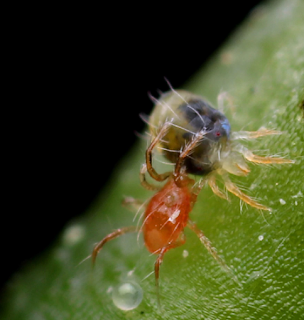
Figure 1. An image of persimilis predating on a two-spotted spider mite. Photo credit: Biotactics Inc. 


This new persimilis can also be purchased in bottle form. But grower be warned! It was interestingly noted that these predators are not their characteristic red colour when you receive them from the insectary. That colour develops on the persimilis as they start feeding on spider mites. This acts as an added bonus when it comes to your scouting efforts. If you note which predators have transitioned from milky to red, you can get a sense of the pest pressure in the space and how effective your release was at managing the spider mite population.

I want to give a huge shoutout to the Cannabis Cultivation & Science Podcast for keeping up with the biocontrol world and spreading the word on cool innovations like this one!

______________________________________________________________

Posted by: Talia Plaskett


Making the Most of your IPM Programs

Friday, October 8, 2021

    You found out that you have an insect infestation in your crop, and identified the causal agent. What comes next in deciding how to handle it?

  1.       You need to consider the life stage of the target pest. Biological controls are skilled at targeting pests, but this can be restricted to certain stages of the life cycle. Those that are specialized at targeting larvae are not going to be able to knock back a population that is mostly comprised of eggs or adults. While interruption of the life cycle is important for combatting pest outbreaks, you won't necessarily limit the feeding damage that is to come as a result of the current population. 
  2.       The life stage of the pest is not the only thing to consider. If you are relying on insects to control your pest population, you need to consider the life stage of the biological you are wanting to use. Releasing eggs compared to releasing larvae can result in different levels of control, establishment and active period in the crop. 
  3.       Life stage, life stage, life stage! Where is the crop at in terms of its production cycle? Some biologicals are best applied in the early stages compared to the later ones. For example, releasing an agent that is going to lay eggs that hatch and congregate around the flowers is going to render your product unusable. 
  4.       What are the growing conditions in the production space? Similar to plants, diseases and insect pests, biological interventions are going to have an optimum set of conditions to maximize performance. This is especially important when you are growing at lower/higher temperatures and abnormal humidity levels. Some biologicals are going to operate better at lower temperatures ( ex. 10C) compared to others, and you don't want to waste your time repeat testing an agent that is not going to thrive in that particular setting.

      Now that we have decided which biological control agents we want to use, there are a few other things to keep in mind. 

  1.       How healthy are the predators that I've ordered? It is important to check the viability of your biological control agents upon receiving them from the insectary. There can be issues with rearing, storage/shipping etc, which can result in sub-optimal pest management. By implementing these health checks before releasing into the crop, you can ensure that you are getting the best quality product and setting your IPM program up for success
  2.       It is ideal that you are always releasing fresh biological agents. By storing them for long periods of thime, you are running the risk that they will parasitize each other in their storage container. You could also be reducing the activity of the agents, and will need to spend more money in the long run. By purchasing the amount that you will release each time around, you are one step closer to maximizing the effectiveness of your agent. 
  3.       Are the agents I've ordered compatible with each other? While it is likely that you will get some overlap of introduced biological control agents targeting each other, you want to make sure that is not the norm
  4.       Are the agents I've ordered compatible with the spray activities happening in the grow room? Oil sprays that are used to suppress insects and disease are not always selective when it comes to drowning out pests.

   Maximizing success and implementing a successful IPM strategy can be a long process, but  taking these things into consideration should help get things started. Preventative pest management strategies are crucial in creating and maintaining a healthy and productive grow space, and there is no time like the present to dive in and re-evaluate your current strategy! 

      Posted by: Talia Plaskett


What to Spray, What to Spray...

Friday, September 10, 2021

Pest and disease management in cannabis is no walk in the park! Not only are you limited in what you can apply to the crop, there are also a lot of products out there to chose from! 

Never fear, Perennia is here!

Every year, the production specialists take the time to create/update our spray guides. These guides contain a wealth of information on registered products, formulations, application rates, REI, PHI and noteworthy comments on working with that particular product. 

While this is no substitute for the actual product label, it can help narrow down the choices of what works best for your grow. Say, for example, you are having an issue with spider mites. You can scroll down to the 'Mites' portion of the guide (or 'control - Find' for the tech savy), and take a look at all of the products that are registered for use in cannabis against mites. 

Some products are going to be more compatible with your production system than others. Say, for example, you have been applying sulfur to manage powdery mildew. Oil sprays are not going to be your best choice to tackle mites in this case, as these may cause some funky side effects on your canopy. This is a fast way to narrow down your search to a product that will be more suitable. 

From there, double check the label, and ensure that you are applying based on their recommendations. Product registrations can change any time of year, and our guides, updated every March, are not going to capture things that have taken place in April...May...June etc. 

Spray happy my friends!


Posted by: Talia Plaskett

Field Research Services

Friday, August 6, 2021


We are excited to share with you the launch of our new Field Research Services webpage! Our new site fully showcases our team and the services available to support agriculture research in Nova Scotia.

Our team's knowledge and skillset ensures we are fully equipped to deliver on-farm extension and small plot research. We pride ourselves on performing quality research to ensure accurate results and client satisfaction.

Learn more about the services we offer and take a look at our projects page to see some of our previous work.

Feel free to reach out to us anytime. We would be happy to discuss your research needs.


Let's Light It Up!

Friday, July 16, 2021

Cannabis production takes place both indoors and outdoors in Nova Scotia. While both production systems have their pros and cons, there is no denying that indoor production allows for increased consistency in environmental conditions, as well as year-round growing (structure dependent).  

For greenhouse producers, one of the major hiccups in year-round production is the amount of light available during the winter months. In order to maximize growth (and yield), certain inputs are required to create continuity and consistency through the seasons - One of these potential inputs is artificial lighting. 


For strictly indoor producers, artificial lighting is crucial. This is what will fuel your plant growth year round, and will make up a significant portion of your initial investment and monthly energy costs. 

For those of you who are considering protected production, the adoption of indoor lighting is a big investment, and there are a lot of variables to consider in the decision-making process. Check out our newest factsheet on greenhouse lighting, which explores the pros and cons of LED versus traditional light fixtures, defines light and the various units used to describe it, as well as the tools required to measure it.   


Posted by: Talia Plaskett


PREVIOUS Bloom to Bud Posts