Showing posts with label Substrate. Show all posts

Managing a Substrate-Based Production System

Friday, May 27, 2022

The shift from soil to substrate is more involved than simply switching the grow medium and hoping for the best. Every base growing material is going to have different physical and chemical properties that impact the way it behaves in production. As a result, management is going to vary across soilless substrates. Despite the differences across alternative grow media, there are a handful of things, however, which do hold true when switching out of soil-based crop production


Irrigation Management is Crucial. 

Managing the water demands of a crop that is restricted to its container is very different than that same crop being grown in 'infinite' soil. The biggest differences you will see is the rate at which it dries out - a 4L pot has a significantly decreased ability to hold moisture compared to a soil-based farm. On that same note, the ability to drain water is also different when producing in a restricted volume of growing media. The potential for over-saturation of the growing media, as well as the heightened risk of salt accumulation, are also important characteristics to be aware of. 

Growing in a container is going to result in a smaller root volume on a plant, which is going to impact the ability to uptake water. For containerized crops we see that water needs to be more readily available for uptake compared to a soil based system. This metric is referred to as 'moisture tension'. Moisture tension can be measured a handful of ways (tensiometers, squeeze tests, capacitance probes), and it is important to recognize that the target moisture tension values are going to be different than a soil-based system. The ideal moisture tension for peat-based tomatoes runs from 1 to -5kPa, which is higher than what a field producer would aim for. By maintaining the moisture tension in this range, the plant roots have consistent access to water that is readily available for uptake. Values higher than this indicate a substrate that is too wet, which will limit air pockets in the media and increase the risk of disease in the roots. Values lower than this mean that your substrate is running too dry for your crop. The miniaturized root system is unable to extract water from the pore spaces in the media, and plant growth will be immediately impacted. 

Fertilizer Management Regime

Soilless substrate inherently contains very little, if not zero, baseline nutrition for your crop. While soil systems rely on pre-treatment of the soil and scattered nutrient applications through the season, a substrate-grown crop should be fertigated multiple times per day. By combining your irrigation and soluble fertilizer applications, you can be sure that the crop is getting the right amount of nutrients to sustain healthy and productive plant growth. 

What happens if I only fertigate once a day, and the remainder of the crop receives straight water? Any fertilizer that has been applied will be significantly diluted, if not completely run out of your substrate by selectively applying fertilizer through the day. Consistency bodes well for containerized crops in producing a healthy and productive root system, so save yourselves the trouble and plan accordingly for your daily watering regime. 

The soluble fertilizers that are being introduced into your system should be monitored on a regular basis. Daily checks of the EC and pH of the water that is being fed to your crop will ensure that your dosing system is working properly and that your fertilizer mix was diluted accordingly. These systems can see change on a daily basis, so it is important to stay on top of it to maintain healthy plant growth.
Speaking of pH....the target values for a soilless substrate are going to be lower than what you are aiming for in a soil-based system. While this depends on what the base material of your growing media is, you can anticipate that the pH of the fertigation solution should be somewhere in the 5.4-5.8 range.

If you are interested in learning more about managing a substrate-based production system, click here to check out our new factsheet. If you have any questions that were not addressed here, don't hesitate to reach out and we will be happy to talk to you about your production setup.

Posted by: Talia Plaskett
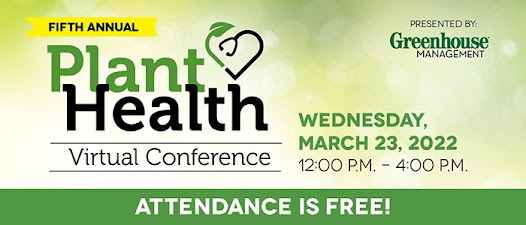

Upcoming Plant Health Virtual Conference

Monday, March 14, 2022

  Get those calendars ready folks, we have another greenhouse webinar coming up! This (FREE) virtual event takes place Wednesday March 23 from 12-4pm EST and focuses on various ways to improve on plant health in controlled environments. 


So, what are we going to be hearing about?

Watching Water Quality - 12:20 - 1:05 pm

Water quality is extremely important to consider for protected production, especially in a hydroponic setup. Water quality can impact long-term root-zone pH and EC, as well as root disease susceptibility, pesticide applications, equipment longevity and appropriate fertilizers. Neil Mattson, Associate Professor at Cornell University, will discuss why and how often you should be submitting your water for a quality test. From there, he will review some of the key aspects to focus on when interpreting the results from the lab, as well as highlight some of the things on that report that are slightly less important to help keep us on track. By understanding your water, and the impact it has on your crop, you can help mitigate any water-based headaches around the facility and help improve the overall growing conditions (and productivity) of the crop

The Physics of Spraying in Closed Environments- 1:15 - 2:00 pm

Jason Deveau, the Application Technology Specialist at OMAFRA will explore the physics of spray application methods that are specific to closed environments. By understanding how spray behaves, and through using simple diagnostic methods to characterize your current spray tendency, operators can improve the efficacy and productivity of the products applied in the protected space.

Quality Assessment of Biological Control Agents (BCA): Why It Is Important to Know if your BCA are Alive or Dead - 2:10 -2:55 pm 

Dr. Raymond Cloyd, Professor/Extension Specialist out of Kansas State University will provide an overview of biological control, and then focus in on the importance of developing quality assessments to ensure that your BCA are functional. Functionality is key for successful insect and mite populations, so it is important to implement these assessments into your usual routine!

Growing Media Selection for Optimized Plant Health - 3:05-3:50 pm

Dr. Brian Jackson, Director of Horticultural Substrates Laboratory at North Carolina State University, is going to talk about the importance of selection and management of growing media. When done properly, it is easier to promote root growth and development, which is crucial for overall plant health and success. Additionally, precise water management of substrates/containers at different times over the cropping cycle of plant production can aid in growth regulation as well as the post production shelf life of plants. Dr. Jackson will also comment on new substrates that are entering the marketplace, and talk about how they compare to traditional mixes when it comes to water management. 

______________________________________________________________

This fantastic line up will help get you start your growing season on the right foot, so definitely consider tuning in if you are looking to improve the quality of your greenhouse plants! 

If you are interested in registering, or learning more about the event, click here

Posted by: Talia Plaskett

Selecting Soilless Substrate

Friday, February 18, 2022


Soilless substrates are used across the world, offering a solution to those with difficult soils to grow on, or those who are looking to increase efficiencies when it comes to nutrient and water inputs. These substrates are comprised of non-soil components, but still provide the structural support needed by the plant in order to grow.

When it comes to the base material used for soilless grow media, there are two groups: synthetic and non-synthetic products. 

How do I chose what substrate to use?

While both synthetic and non-synthetic substrates are good options for providing structural support, nutrients and water to the plant root system through the cropping cycle, there are a few key questions to consider when purchasing a growing media:

1) What is the cost? 

Substrates are not created equally when it comes to cost. It is not recommended, however to chose the cheapest/most expensive one without understanding what you are getting with it. It is definitely an important factor to consider, but make sure that you understand the rest of the list below when making your choice. 

2) Where is the material coming from?

In COVID times, shipping delays are all too real for producers of all shapes and sizes. This should definitely be a consideration if you have yet to order your growing media for the upcoming season. There are many local substrate providers who might be able to fill your needs without having to ship overseas. 

3) What is the baseline nutritional status of the media?

While soilless substrates do not have much to offer in terms of baseline nutrients, it is important to realize that there are differences between the base materials. Some substrates are going to be more prone to having high initial salt levels compared to others, and if the media is not treated properly, these salts can be very damaging to your new crop. Be sure to ask your provider about your substrate and the treatments it has received. 

4) What is the particle density, porosity and particle size range of my substrate? 

These are key parameters that are going to determine how well or how poorly your substrate holds on to water. A substrate with tiny particles, means that the air and water spaces within your media are also going to be very small. This makes it harder for the plant to pull water out of those air spaces. It is also difficult for this water to drain out of the media, meaning the roots are more prone to sit in a wet matrix, regardless of the time of day. This has a tendency to lead to root disease and sub-optimal plant productivity. On the other end of that spectrum, large particles have very little capacity to hold onto water, meaning you are significantly increasing the number of irrigation events throughout the day to sustain plant growth. 


5) How do I want to handle my substrate?

Substrate is available for purchase in a few different forms. It can be purchased in large bulk orders, where the producer must hydrate, divide up into the individual growing containers, and then move those containers into the growing space. The other option is to purchase pre-filled slabs (also referred to as grow bags). Some crops have the option for specialized containers that help mitigate some production issues that typically develop down the line, while others don't. It is up to the producer, the target crop, and the labour force available, to decide which method is going to work best for that particular operation. 

6) What am I going to do with my substrate now that I'm finished with it?

This is where things get a little hairy. Synthetic substrates cannot be composted, and usually require transport off site for disposal. Non-synthetic substrates do have the option for composting, but must be done in a strategic way to prevent the accidental creation of an oasis for lingering insects and disease. This
plays in to point number 5 as well - removing the inner contents of a slab wrapped in plastic is much more time consuming to compost compared to a crop grown in a container.  
 

_________________________________________________________________________
For those who are new to growing in substrate, these questions can be overwhelming...but never fear! Your Protected Crop Specialist is here. If you have any questions on soilless substrates check out some of Perennia's resources:

Water Woes

Tuesday, May 11, 2021

Irrigation management can be tricky, especially for those who are experimenting with new systems. From field producers who want to see more consistency in their watering, to those moving into an indoor production space, to those who are experimenting with soilless substrate, we have you covered! The commodity specialists at Perennia decided it was time to buckle down and tackle irrigation as a whole. 

Introducing our "Getting into the Weeds" Series! These sessions were designed to start with the basics, and build up from there, addressing some of the most commonly asked questions in plant agriculture. 


Session 1: Water Movement through the soil - make every drop count
Session 2: Planning and Design of a Drip Irrigation System
Session 3: Operating and Managing a Drip Irrigation System
Session 4: Pivot and Guns: Irrigation System Management
Session 5: Fertigation: Integrating Nutrients with Irrigation Options
Session 6: Making the Switch to Soilless Substrate
Session 7: Irrigating my Soilless Substrate 
Session 8: Disease Management in Irrigated Crops 

Be sure to check these out, and see how your irrigation practices compare! 


Posted by: Talia Plaskett 

PREVIOUS Bloom to Bud Posts