Showing posts with label Production. Show all posts

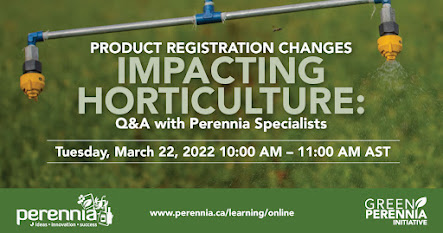
Product Registration Changes Impacting Horticulture

Monday, February 28, 2022

 Q&A with Perennia Specialists

Perennia's commodity specialists are coming together to talk about product registration changes that will be coming into effect for 2022. This is a great opportunity to catch up on all things product related, and ask your specialist any questions you may have when it comes to label changes, use patterns and new/discontinued products. 

The focal crops during the session are apples, wild blueberries, cranberries, vegetables, berries, cannabis, and field crops. Each specialist will bring information on products that are relevant to their sector. In this conversational style webinar, we’ll answer frequently asked questions and live questions that you submit.

 For more information on the webinar, and session registration, click here

Getting Into the Weeds: Farming in a Humid Year

Thursday, November 18, 2021

Every year, Perennia's Horticulture Team sits down to discuss what major issues, questions and themes came up throughout the growing season. While there are differences between the crops grown here, we are typically able to identify pain points that are applicable to all producers. Last year, with the unexpected hot weather and lack of rainfall, we decided to tackle the basics surrounding irrigation. We wanted to make sure that everyone was on the same page on how to design and implement an irrigation system, for both soil and substrate based systems. For those of you who missed it, or are interested in a refresher...you can find all of these sessions here.

So what were the major challenges of 2021 you ask? 

Most producers can agree that there was significantly more rainfall and a higher humidity measured throughout the growing season than what we would typically experience. So, with that, enter our theme for the upcoming 'Getting Into the Weeds' Webinar series...Farming in a Humid Year!

November 23 - Understanding the Infection Cycle: Targeting Effective Disease Management

November 30 - Year in Review: A Disease Summary of 2021 - What Did We Learn?

January 12 - The Fundamentals of Fungicides

February 3 - Why Herbicides Fail: Targeting Effective Herbicide Application


If you are interested in learning more and/or registering for these free webinars, check out our list of upcoming online sessions. 


Posted by: Talia Plaskett

Making the Most of your IPM Programs

Friday, October 8, 2021

    You found out that you have an insect infestation in your crop, and identified the causal agent. What comes next in deciding how to handle it?

  1.       You need to consider the life stage of the target pest. Biological controls are skilled at targeting pests, but this can be restricted to certain stages of the life cycle. Those that are specialized at targeting larvae are not going to be able to knock back a population that is mostly comprised of eggs or adults. While interruption of the life cycle is important for combatting pest outbreaks, you won't necessarily limit the feeding damage that is to come as a result of the current population. 
  2.       The life stage of the pest is not the only thing to consider. If you are relying on insects to control your pest population, you need to consider the life stage of the biological you are wanting to use. Releasing eggs compared to releasing larvae can result in different levels of control, establishment and active period in the crop. 
  3.       Life stage, life stage, life stage! Where is the crop at in terms of its production cycle? Some biologicals are best applied in the early stages compared to the later ones. For example, releasing an agent that is going to lay eggs that hatch and congregate around the flowers is going to render your product unusable. 
  4.       What are the growing conditions in the production space? Similar to plants, diseases and insect pests, biological interventions are going to have an optimum set of conditions to maximize performance. This is especially important when you are growing at lower/higher temperatures and abnormal humidity levels. Some biologicals are going to operate better at lower temperatures ( ex. 10C) compared to others, and you don't want to waste your time repeat testing an agent that is not going to thrive in that particular setting.

      Now that we have decided which biological control agents we want to use, there are a few other things to keep in mind. 

  1.       How healthy are the predators that I've ordered? It is important to check the viability of your biological control agents upon receiving them from the insectary. There can be issues with rearing, storage/shipping etc, which can result in sub-optimal pest management. By implementing these health checks before releasing into the crop, you can ensure that you are getting the best quality product and setting your IPM program up for success
  2.       It is ideal that you are always releasing fresh biological agents. By storing them for long periods of thime, you are running the risk that they will parasitize each other in their storage container. You could also be reducing the activity of the agents, and will need to spend more money in the long run. By purchasing the amount that you will release each time around, you are one step closer to maximizing the effectiveness of your agent. 
  3.       Are the agents I've ordered compatible with each other? While it is likely that you will get some overlap of introduced biological control agents targeting each other, you want to make sure that is not the norm
  4.       Are the agents I've ordered compatible with the spray activities happening in the grow room? Oil sprays that are used to suppress insects and disease are not always selective when it comes to drowning out pests.

   Maximizing success and implementing a successful IPM strategy can be a long process, but  taking these things into consideration should help get things started. Preventative pest management strategies are crucial in creating and maintaining a healthy and productive grow space, and there is no time like the present to dive in and re-evaluate your current strategy! 

      Posted by: Talia Plaskett


Introducing...Perennia Cannabis Services!

Thursday, April 29, 2021

Perennia is an organization known across Nova Scotia for providing a variety of services in agriculture, quality and food safety, product development, lab services and fisheries. Within the lab services division sits Bloom Labs - a name you may be more familiar with.

Bloom labs is a Health Canada-licensed cannabis testing lab that provides mandated, luxury and custom analytical services. These are available to all growers including micro-producers, large facilities and recreational growers.

Until now, agriculture services were limited when it came to cannabis. With the introduction of a new staff member dedicated to Protected Crop (greenhouse, tunnel, indoor facilities etc.) production, there was an opportunity to expand our offerings in the world of cannabis - in comes Talia Plaskett!

Talia has spent the last 11 months diving into Nova Scotia horticulture. Through introductions to producers and tours of ornamental, berry, vegetable and cannabis facilities, she has a good understanding of the challenges and opportunities within the province when it comes to commercial production. While the challenges in cannabis are unique, there are many similarities that exist across other commodities, and drawing on that experience will be beneficial to cannabis producers of all sizes.

What do our agriculture services look like? It comes in a variety of forms.

  •  Virtual correspondence regarding questions you have about your production system
  •   Site tours to help set the stage for your growth
    • Beneficial for identifying the cause of any issues you may be experiencing
    • Creates an open dialogue between you and the production specialist
  • Fact sheets and webinars
    • Allows us to address industry-wide gaps in understanding, as identified through conversations with growers
  •   Fee-for-Service Consultation
    • These projects will vary from facility to facility. Feel free to reach out to discuss an issue that requires specialized and focused attention

Talia is not the only new addition to the cannabis service team - meet Chelsea Meisner! Working with our analytical team, Chelsea can help with all aspects of the product development process including large scale development, manufacturing of edible cannabis products and shelf-life evaluations.

During 2019 Chelsea had a key role in developing some of the top-selling cannabis edible products currently on the market in Canada. As a Food Scientist, Chelsea has over ten years of experience in product development, quality control and manufacturing. The cannabis industry is growing and constantly changing as many companies are developing edibles. There is a lot of innovation and science happening to help create the best products for consumers. We are all still learning the interesting and challenging world of cannabis, and through the Product Development services at Bloom Labs, Chelsea hopes to provide knowledge and support to the industry.

What do our product development services look like?

  • Formula Development
    • Prototype bench top development of uninfused and infused products
    • Cannabis incorporation
  •  Ingredient sourcing and costing of formulations
  • Process development that can be scaled up to meet current processing capabilities or capabilities of a co-packer
  • Child-resistant packaging sourcing
  • Regulatory requirements
  • Scale Up Assistance
  • Shelf-Life Evaluations

Talia and Chelsea look forward to connecting with you and learning how they can help you and your operation succeed! If you have any questions about how Perennia can support you, don't hesitate to reach out

PREVIOUS Bloom to Bud Posts