Showing posts with label Nutrient Analysis. Show all posts

Identifying Plant Nutrient Uptake under Different Concentrations of N

Wednesday, February 1, 2023

Martine Dorais from Laval University presented her work on plant nutrient uptake in cannabis at the 2022 Canadian Greenhouse Conference. A summary of her presentation can be found below:

One of the first thing she presents is a look at the difference in water use for two different rates of N supplementation. While there is an obvious spike of water uptake in week two for the plants receiving 250 ppm N, the differences in water use between the two treatments quickly levels out over time. Depending on your fertigation plan, more or less water may be necessary for your crop in those first few weeks of growth. 


Next up, her team decides to explore how different rates of N are going to impact the uptake of other key nutrients. Below, we can see the response of K uptake, and Ca uptake as a response to the amount of N in the system. Both nutrients see a significant spike in uptake at week two in the 250 mg/L N treatment, however the shape of the uptake curve is not necessarily reflected in the 150 mg/L N treatment. The different uptake patterns is an interesting trend to note here, which has implications for fertilizer recipe ratios over time depending on what level of N you are feeding. 


The next analysis looks at the uptake rate of P-PO4 and Mg. Right off the bat, we see that the nutrient uptake patterns here are quite different to what was observed above. For P-PO4, instead of seeing a spike at 2 weeks, the uptake spike happens around week 5 of growth. Mg sees a peak at week 2, but again at week 6, with similar patterns across the two treatments of N. In the case of both of these nutrients, I think that noticing the scale for these graphs (significantly lower uptake rate compared to that of K and Ca) as well as her note that the amount of N supplemented did not have a significant impact on nutrient uptake. From a recipe formulation standpoint, levels of Mg and P-PO4 can stay relatively constant when increasing/decreasing the amount of N being fed to the crop. 

How does this translate to our final product?

It's becoming widely accepted that different strains of cannabis do not behave the same way, not just in a the sense that they produce different plant architectures, but in their responses to different environmental conditions as well. The results presented below are a perfect example of that. White Shark saw a 29% increase in dry inflorescence weight per plant as a result of the higher N feed. Critical Orange Punch, however, did not differ significantly in the dry weights produced.


Take this one step further, Martine's team wanted to see the impact of the two different rates of N on the % of cannabinoid production, and the study yielded some interesting findings: 

Cannabinoids (%)

N-NO3 Concentration


250 ppm

150 ppm

THCA

17.98

18.47

Delta9-THC

0.31a

0.14b

CBDA

0.28

0.02

CBD

0

0

CBDV

0

0.04

CBN

0.31

0.29

CBG

0.04

0.06

CBGA

0.35

0.57

CBC

0

0.91

Total THC

16.13b

17.66a

Total CBD

0.25

0.03

While Delta9-THC was significantly higher at the 250 ppm N rate compared to the 150 ppm rate, the total THC levels show that the lower supplemented N rate of 150 ppm actually yielded a higher percentage of cannabinoids compared to the higher rate of N. In this particular case, more N was not necessarily conducive to bigger and better quality product. Studies like this are crucial for being able to target nutrient supplementation to important time stamps, as well as begin to understand exactly what goes into growing the best possible flower. 

Martine Dorais' team produced a lot more results than what I have summarized here, and I encourage you to explore the entire presentation to see the full scope of work that was conducted. You can find the entire slide deck here.

Posted by: Talia Plaskett

Upcoming Webinar: Phosphorus and Cannabis - How much is Enough?

Friday, April 22, 2022

April 28, 12:00 - 1:00 pm EST sets the stage for the next webinar in the GrowON series, organized by extension staff at OMAFRA. As the cost of fertilizer increases, greenhouse growers of all shapes and sizes are looking for ways to optimize nutrient use efficiency in order to manage the costs of the inputs. Phosphorus, being an important nutrient for plant production, is the focus of today's talk. Bill MacDonald, the coordinator of the commercial cannabis program at Niagara College, will talk about the results of phosphorus deficiency trials conducted over the last few years in Cannabis. Following this discussion, there will be a review of other nutrition work that has been done to help dial in the ideal recipe for your crop. 


In September 2018, Niagara College became the first post secondary institute in Canada to obtain a Health Canada license specifically to grow cannabis with the intention of training students. Prior to joining Niagara College, Bill MacDonald owned and managed greenhouses, and spent 8 years consulting in the cannabis industry. He has a Bachelor of Science in Agriculture and a Master of Science in Plant nutrition from the University of Guelph, so he is well versed in all things cannabis nutrition.

If you are interested in learning more about the role Phosphorus plays in your crop, and getting a better idea of the impact of varying nutrient levels on your crop, click here to register for the session. 


Posted by: Talia Plaskett

Below the Surface - What Else is your Soil Test Telling you?

Friday, April 1, 2022

If you haven't watched Perennia's latest webinar on interpretation of soil reports...run, don't walk, to our Youtube channel! (Just kidding, you can also click here). 

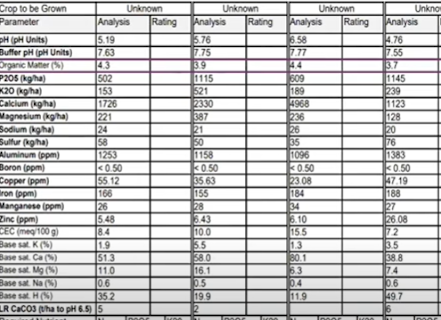
Join our soil specialist Caitlin McCavour as she goes through the results generated from a soil sample submitted to the NSDA testing lab, and further explains what those values mean, and the impact it has on your crop. For the record, while this report might look similar to what is generated for a substrate-based nutrient analysis, they are not the same test! Make sure to double check the analysis you are requesting, and that it is suitable for the growing media you are using in your operation. 

Below you can find some of the questions she answers throughout the webinar: 

Go through the Elements of the Soil Test Report

What is the difference between the posted pH and the buffer pH row?
Where can I find the recommended amount of lime required for pH adjustment?
How do you select the best amendment to increase soil pH ?
Why is organic matter important?
Essential elements for plant production 
What are the ranges used to determine if my levels are low or high?

Cation Exchange Capacity

What influences the ability of a soil to have an increased or decreased ability to hold onto cations?
Who are the acidic and basic players? Are they considered equal in binding capacity?
How is this going to change your management practices?
The role of CEC in timings and volume of fertilizer applications

Base Saturation

What is base saturation?
How is it different from cation exchange capacity?


Rather than trying to summarize all of the awesome information here, I highly recommend you sit through the 52 minute webinar. If you have any questions about your soil test, and the management recommendations that go along with it, don't hesitate to reach out !


Posted by: Talia Plaskett 

PREVIOUS Bloom to Bud Posts