Showing posts with label Beneficials. Show all posts

Cannacopia – Key Concepts for Cannabis Success

Tuesday, April 19, 2022


Introducing the first official workshop hosted by the BloomLabs team! This presentation can be viewed on YouTube at https://www.youtube.com/watch?v=sbb-PNiTFpc. Please follow this link if you’re interested!  

Topics of discussion included the following:

Sarah discusses facility and product overview from Olli Brands Inc., a leader in cannabis edibles in Canada, who has tons of great and unique flavours to try! P.S. You may want to try their chocolate brownies or cookies! Sarah outlines new product development processes and how Olli can help you bring your ideas to life.

Mike, from Professional Cleaning Solutions, discussed cleaning in the industry. Sanitation is a key concept for any cannabis producer to mitigate any mould or mildew, including affecting the environment negatively. Mike chats about topics like training, health and safety, environmental impacts, Good Production Practices (in the Cannabis Regulations!), sanitation and environmental programs, and more!

Dr. Punja discusses the various pathogens in greenhouses, which can be compared to indoor growth as well. Diseases infect roots, foliage, as well as flower and are all important when growing cannabis, especially for disease management. Dr. Punja discusses the types of pathogens, as well as biological controls that can mitigate the diseases. If you have powdery mildew, moulds, root rot, etc., check out this presentation! Afterall, it is very common, cannabis is a live flower!

Ricardo, our Senior Microbiologist at BloomLabs, discusses the concerns with bacterial and mould contaminants. Ricardo walks through the types of bacteria and mould we test for at BloomLabs in cannabis. Cannabis can have some anti-microbial properties, but as it is for human consumption, producers must make sure it’s safe for human health. This presentation identifies contamination points during production and discusses services Bloom offers to help mitigate issues, such as air quality testing, environmental swabbing, etc.

Services from the BloomLabs Cannabis Accelerator Team, Talia and Chelsea, include production services, from seed to sale, including irrigation systems, substrate information, pest management practices, and more! We also offer cannabis edible product development, as well as shelf-life studies! We work with clients from start to finish to get their products to the market. BloomLabs can work with you, either on site or online, to grow your company and products


BloomLabs had a great time hosting this workshop and we plan to host more of these types of information sessions! We allowed for Q&A period which many viewers got to ask specific questions about products or requirements. Please keep an eye out for our next workshop (we’ll also be sending an email out to our current email list, so please reach out if you’d like to hear from us!)!

What's New with Biological Control?

Tuesday, November 9, 2021

 2021 has seen a lot of new and exciting things in the world of IPM with some of the tools available to producers for managing pest populations. Please find a quick summary of some of these new developments below with their corresponding contact information – this is a list of curated material from various sources, credit must be given where credit is due!

1)Introducing Anystis, the new generalist predator in our toolbox

 Anystis is a new generalist predator which was discovered and trialed by Vineland Research and Innovation Centre. This predator has shown control over thrips and spider mites as well as suppression of aphid populations. Not only that, but it also preys on Echinothrips and mealybugs, which currently do not have effective options when it comes to biological control agents! Not only that, but Anystis is compatible with other commonly used biocontrol agents, meaning less stress about adjusting your current regimes and more success overall when it comes to targeting your problematic pests. 

The use of Anystis has been validated in commercial greenhouse trials on gerbera and sweet pepper in Ontario, and further supported by promising results generated through recent trials at Niagara College for use in cannabis to control aphids. The predator has been transferred to Applied Bio-nomics Ltd for scaling up the rearing system and commercialization, and have a limited number of mites available for growers to try.

For more information on Anystis, contact Rose Buitenhuis, PhD Senior Research Scientist, Biological Control at Vineland Research.


2)Slow-release method of nematodes

The current application of beneficial nematodes is limited to sprenches, or drenches, across the surface of the growing media. The biggest targets for beneficial nematodes are the larvae of fungus gnats and western flower thrips, as well as onion thrips pupae. While the product is quite effective, the current application method to the crop sees a few technical difficulties. These drenches/sprenches are not the most effective when it comes to penetrating deeper into the growing mix, and they must be applied on a weekly basis. Not only that, but the current methods of distribution sees a very poor storage capacity – all must be distributed at once, which leaves the small producers in a bit of a financial pinch!

E-Nema is a new tech company based in Germany. They have come out with a slow-release method for these beneficial nematodes which tackles some of the difficulties associated with the existing system. These look similar to tapioca pearls, and are designed to be incorporated into the growing mix before planting. Then, over time, they will slowly release nematodes through the entirety of your growing container. These pearls are very safe, and do not contain any harmful chemicals. In addition to that, they store quite well, which is a win for smaller producers who may not need massive volumes to be distributed all at once. The reintroduction and inoculation of low doses of nematodes has proven to be more effective than coming in hot and heavy with one dose during the cycle, and this technology allows just that! 

BioBee will be the distributer for this new product, so be sure to keep your eyes peeled for that! I want to give a huge shoutout to the Cannabis Cultivation & Science Podcast for keeping up with the biocontrol world and spreading the word on cool innovations like this one!


3)New rearing methodology for Phytoseiulus persimilus

Our old reliable predatory mite is coming at us new and improved! BioBee has re-evaluated their current rearing methods for persimilis and has landed on a product that addresses some of the downfalls to the original release system. The original system sees that the predators are reared on spider mites, meaning they come out of their sachets starved and ready to tackle some serious spider mites. While that works well in heavily infested crops, it doesn’t bode well for the low pest pressure grow room, or the preventative release strategy either. This new product raises the predators on mite eggs, meaning that each sachet will come with a variety of life stages, and each sachet will have a long-life span overall as these different stages progress towards adulthood. These sachets can see up to 12 days to release the contents, giving you almost 2 weeks of release from one purchase. The new food source sees that these mites are not as hungry as they would be when raised on spider mites. This means they have time to establish in the crop, as well as hunt down those low density mites that are scattered through the room. Not only that, but there is no carrier mixed in with these predators. This is a huge win for producers of heavily-trichomed crops, as their plants will no longer be littered with pesky lingering carrier bits.
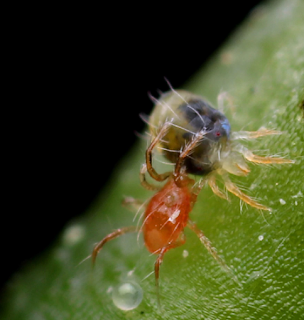

Figure 1. An image of persimilis predating on a two-spotted spider mite. Photo credit: Biotactics Inc. 


This new persimilis can also be purchased in bottle form. But grower be warned! It was interestingly noted that these predators are not their characteristic red colour when you receive them from the insectary. That colour develops on the persimilis as they start feeding on spider mites. This acts as an added bonus when it comes to your scouting efforts. If you note which predators have transitioned from milky to red, you can get a sense of the pest pressure in the space and how effective your release was at managing the spider mite population.

I want to give a huge shoutout to the Cannabis Cultivation & Science Podcast for keeping up with the biocontrol world and spreading the word on cool innovations like this one!

______________________________________________________________

Posted by: Talia Plaskett


Making the Most of your IPM Programs

Friday, October 8, 2021

    You found out that you have an insect infestation in your crop, and identified the causal agent. What comes next in deciding how to handle it?

  1.       You need to consider the life stage of the target pest. Biological controls are skilled at targeting pests, but this can be restricted to certain stages of the life cycle. Those that are specialized at targeting larvae are not going to be able to knock back a population that is mostly comprised of eggs or adults. While interruption of the life cycle is important for combatting pest outbreaks, you won't necessarily limit the feeding damage that is to come as a result of the current population. 
  2.       The life stage of the pest is not the only thing to consider. If you are relying on insects to control your pest population, you need to consider the life stage of the biological you are wanting to use. Releasing eggs compared to releasing larvae can result in different levels of control, establishment and active period in the crop. 
  3.       Life stage, life stage, life stage! Where is the crop at in terms of its production cycle? Some biologicals are best applied in the early stages compared to the later ones. For example, releasing an agent that is going to lay eggs that hatch and congregate around the flowers is going to render your product unusable. 
  4.       What are the growing conditions in the production space? Similar to plants, diseases and insect pests, biological interventions are going to have an optimum set of conditions to maximize performance. This is especially important when you are growing at lower/higher temperatures and abnormal humidity levels. Some biologicals are going to operate better at lower temperatures ( ex. 10C) compared to others, and you don't want to waste your time repeat testing an agent that is not going to thrive in that particular setting.

      Now that we have decided which biological control agents we want to use, there are a few other things to keep in mind. 

  1.       How healthy are the predators that I've ordered? It is important to check the viability of your biological control agents upon receiving them from the insectary. There can be issues with rearing, storage/shipping etc, which can result in sub-optimal pest management. By implementing these health checks before releasing into the crop, you can ensure that you are getting the best quality product and setting your IPM program up for success
  2.       It is ideal that you are always releasing fresh biological agents. By storing them for long periods of thime, you are running the risk that they will parasitize each other in their storage container. You could also be reducing the activity of the agents, and will need to spend more money in the long run. By purchasing the amount that you will release each time around, you are one step closer to maximizing the effectiveness of your agent. 
  3.       Are the agents I've ordered compatible with each other? While it is likely that you will get some overlap of introduced biological control agents targeting each other, you want to make sure that is not the norm
  4.       Are the agents I've ordered compatible with the spray activities happening in the grow room? Oil sprays that are used to suppress insects and disease are not always selective when it comes to drowning out pests.

   Maximizing success and implementing a successful IPM strategy can be a long process, but  taking these things into consideration should help get things started. Preventative pest management strategies are crucial in creating and maintaining a healthy and productive grow space, and there is no time like the present to dive in and re-evaluate your current strategy! 

      Posted by: Talia Plaskett


Proper Release of Biological Control Agents

Friday, May 7, 2021

Biological control is a key part of managing pest populations in cannabis production. While it is extremely important to conduct regular scouting and know the appropriate control methods to tackle your target pest populations it does not guarantee a successful biological control program.

It is important to check the quality of the product you are receiving from the insectary: 

  • Are the biologicals alive? 
  • Are they of good quality and form? 
  • Were they stored and shipped properly? 

There are countless stories of producers who received product that was sub-optimal, and their IPM programs suffered as a result. By checking the quality of every shipment you receive from your insectary, you are one step closer to a successful biological control program. This does not guarantee that the product will be high quality, but you will be able to salvage the situation. Contact the insectary, voice your concerns, and be prepared to put in another order of biologicals. The alternative? Vast amounts of time and money spent on a program that is not working effectively, and a crop infested with pests.

Now that you know that your biologicals are in good form, it is time to release them! Knowing where in the crop to place them, how to properly store them, and the best way to handle the insect housing, are all important to maximize pest control. OMAFRA and the team at Vineland Research and Innovation Centre got together to talk about the proper release of biological controls. Click the following link to watch the video and see how your practices hold up!


Posted by: Talia Plaskett

PREVIOUS Bloom to Bud Posts